Information in this guide is accurate as of August 2026. Shop hours and locations change often, so confirm before making a special trip.
Shibuya is where Tokyo’s record trade is at its densest. Within a ten-minute walk of the station — and most of it inside one neighbourhood, Udagawacho — you can go from a department-store floor holding roughly 100,000 records to a basement jazz shop about the size of a walk-in wardrobe. No other part of the city packs this many specialists into this small an area.
That density is also the catch. Shibuya rewards a plan more than it rewards wandering, because almost every shop here is a specialist: walk into the wrong one and you have spent an hour looking at a genre you do not collect. This guide covers seven stops, what each is actually good for, and how to string them together on foot.
Before the list, one thing worth clearing up: three of the shops that English-language guides still send people to are not in Shibuya any more. Two closed and one moved out of the district. There is a section on them below — read it before you plan a route, because one of them will take you up the wrong hill.
- 1. Tower Records Shibuya
- 2. Face Records
- 3. HMV record shop Shibuya
- 4. Disk Union Shibuya (four separate shops)
- 5. next. records
- 6. Hi-Fi Record Store
- 7. discland JARO
- Three shops that other lists still put in Shibuya
- The one shop that opens at ten
- The density is vertical, not horizontal
- What Japan is actually good for
- How to dig in Shibuya
- Getting your finds home
1. Tower Records Shibuya
The obvious opener, and a genuinely useful one. The nine-floor Shibuya flagship gives its sixth floor over to vinyl — roughly 100,000 records across every genre — which makes it the one shop in the neighbourhood where you can browse broadly rather than deeply. It is also open latest by a wide margin, so it works as a place to end the day when everything else has shut. A cafe and a bookstore in the same building make it an easy meeting point if you are digging with people who are not.
1-22-14 Jinnan · about 3 minutes from Shibuya Station (Hachiko exit) · 10:00–23:00 · vinyl on 6F
Tower is the one stop on this list where the stock is new, and where Japanese first-press editions with bonus discs can be gone within a week of release. If the edition you wanted has already sold out, or you would rather not carry the sixth floor home in hand luggage, CDJapan ships the same domestic pressings with the obi attached, and Buyee bids on Yahoo! Auctions and Mercari for anything already out of print. Worth checking before you go, so you know which titles are worth hunting in person.
2. Face Records
A Shibuya secondhand institution, strong in jazz, soul, funk, reggae and world music, with bins tight enough that you can work through them properly in half an hour. Worth knowing: the Udagawacho shop was closed for an extended period and only reopened in April 2026, for its thirtieth anniversary, at the same address — so recent-looking reports that it is shut are out of date. There is a second branch inside Miyashita Park (6-20-10 Jingumae, 3F) if you find the main shop closed.
Shin-Tokyo Building 3F, 10-2 Udagawacho · about 8 minutes from Shibuya Station · 13:00–19:00 · no fixed closing day, but irregular closures happen
3. HMV record shop Shibuya
HMV’s vinyl-dedicated store, spread over two floors and carrying something like 80,000 titles, roughly 60% of them records. The stock leans hard toward the 1960s through the late 1990s, and the Japanese pop and city pop sections are the reason most visitors come. It is the best-organised deep browse in Shibuya: prices are marked clearly, condition grading is reliable, and there is enough room to actually stand and flip.
Noa Shibuya 1F–2F, 36-2 Udagawacho · about 7 minutes from Shibuya Station · 11:00–21:00 · open year-round
4. Disk Union Shibuya (four separate shops)
Disk Union does not run one Shibuya store; it runs four, each built around a different scene, and knowing which is which saves a lot of walking. ROCK in TOKYO (YY Udagawa Bldg. B1F, 32-7 Udagawacho) is the rock shop, and replaced the old Shibuya used centre — older listings still give its former address. Union Record Shibuya sits in the basement of Shibuya PARCO (15-1 Udagawacho) and is the most comfortable of the four to browse. The Jazz / Rare Groove shop and the Club Music shop share one building, Antenna 21 at 30-7 Udagawacho, on the fifth and fourth floors respectively — two floors, two very different rooms, one lift.
All in Udagawacho, 5–9 minutes from Shibuya Station · weekdays 12:00–20:00, weekends and holidays 11:00–20:00 · the PARCO branch follows the building’s own hours
5. next. records
A second-floor room of around 10,000 titles built for hip hop, R&B, disco and house heads, with a serious 12-inch singles wall and a steady flow of US and European imports. If you are chasing a specific single rather than an album, this is the first place in Shibuya to try. New stock traditionally lands on Friday evenings, which is worth timing a visit around.
Yanagimitsu Bldg. Main Building 2F, 11-11 Udagawacho · 6–9 minutes from Shibuya Station · 13:00–20:00
6. Hi-Fi Record Store
Specialists in American analogue pressings — pop, folk, rock and jazz — and the shop to visit if pressing and condition matter more to you than volume. Grading here is careful and the pricing reflects it. Note that it is technically in Jingumae rather than central Shibuya, on the Harajuku side, so it pairs naturally with a walk up Meiji-dori rather than with the Udagawacho cluster.
Perrier Jingumae 3F, 6-19-17 Jingumae · about 8 minutes from Shibuya Station · 12:00–19:00 per the shop’s own site, though other listings say later — check before a long detour
7. discland JARO
Down a narrow staircase, a jazz shop the size of a small bedroom that has been trading since 1973 and holds somewhere north of 8,000 records, weighted to 1950s and 1960s modern jazz. It is the closest shop on this list to the station and the most old-school: cramped, quiet, and run by someone who knows exactly what is in every crate. Ask.
B1F, 26-6 Udagawacho · 2–4 minutes from Shibuya Station · roughly 10:30–12:30 and 13:30–18:00, closed over lunch · closed Thursdays · hours are the least certain on this list
Three shops that other lists still put in Shibuya
Technique, the dance and club specialist, closed permanently in 2022 when its operating company went into bankruptcy proceedings. It had traded for about thirty years. Ex-staff run an online-only successor, but there is no shop to visit.
Lighthouse Records left Shibuya in September 2025, after seventeen years in the same Dogenzaka building — its final Shibuya trading day was around the 25th. The building is due to be rebuilt after summer 2026 and the shop moved out at the end of its lease rather than renew. It is now in Kanda-Surugadai, near Ochanomizu, which is a different trip on a different line. English listings still give the Dogenzaka address and 14:00–22:00 hours.
Recofan’s Shibuya BEAM shop closed on 11 October 2020 — an 800-square-metre floor holding something like half a million records, gone. Recofan itself is very much alive and back in Shibuya (see below), but not at that address, and not in that building.
The pattern behind all three is worth noticing: Dogenzaka now has essentially no record shop left. The trade has concentrated into Udagawacho, with a small second pocket in Jinnan. If a guide sends you up Dogenzaka to dig, it was written before 2025.
The one shop that opens at ten
Recofan reopened on 1 December 2022 on the 6th floor of MAGNET by SHIBUYA109, the building right at the Hachiko crossing, and it runs 10:00–21:00, closed only on 1 January. Roughly 150,000 CDs and 20,000 LPs. It is not in the seven above because it is a big general floor rather than a specialist — you go for volume and for the chance of something cheap, not for a curated wall. But it is the only serious option in Shibuya before about eleven, and the only one still open at half past eight in the evening, which makes it the natural bookend at either end of a digging day.
Everything else runs later. All four Disk Union shops keep an identical clock: 12:00 on weekdays, 11:00 at weekends and public holidays, closing at 20:00. That is a chain rule, not a per-shop quirk, so there is no point walking between them hoping one opened earlier. The independents open later still — 13:00 is common and some specialists further out do not lift the shutters until 14:00 or 15:00.
Closing time is the consistent part. Almost nothing in Shibuya sells records after 21:00, and most stop at 20:00. A Shibuya record day is roughly six hours long, from eleven to eight, and it does not stretch.
The density is vertical, not horizontal
The Udagawacho shops sit between banchi 10 and banchi 36 — about five hundred metres, six to eight minutes end to end at walking pace. You are not covering ground. You are covering floors.
Between them these shops occupy B1, 1F, 2F, 3F, 4F, 5F and 6F of ordinary commercial buildings, and two of the Disk Union shops are stacked in the same building on the fourth and fifth floors. Almost none of it is visible from the street. The practical consequence is that wandering does not work here: you need the floor numbers, or you will walk past four shops without seeing one.
Two bits of context that help you read the district. “Cisco-zaka” is not an official place name — it is the slope running up from Udagawacho, named after CISCO RECORDS, which stood there; at the 1990s peak that one slope carried more than fifty shops. And Shibuya is not even Disk Union’s biggest cluster: the chain has 55 shops nationwide, of which Shinjuku has fourteen against Shibuya’s four. Shibuya is the densest mix of independents, not the biggest pile of stock.
What Japan is actually good for
If you are flying in, the useful question is not “where are the records” but “what is here that is not at home”. There is a real answer. At one Shibuya shop that has published its numbers, about 90% of new-record buyers are overseas visitors, and new vinyl sales rose around 20% in 2025. Three things drive it: lo-fi hip hop, above all Nujabes; anime and Ghibli soundtracks; and city pop — Anri, Tatsuro Yamashita — where new Japanese pressings are genuinely hard to buy anywhere else.
The market underneath that is growing, not nostalgic. Japanese analog record production passed ¥8 billion in value in 2025 — the first time since 1988, and the fifth consecutive year of growth in both units and value. It is still under 5% of the 1980 peak, so this is a specialist trade rather than a revival, but it is a specialist trade that is expanding.
One caveat on the 90% figure: it is a single shop, self-reported, and it covers new records only. Most of what Shibuya sells is used, and the used crates are still mostly worked by locals.
How to dig in Shibuya
Get the geography right and the day plans itself. Six of these seven stops sit in Udagawacho, the grid of streets running north-west from the Hachiko crossing behind Tower Records. discland JARO is nearest the station; Face Records, HMV, next. records and the Disk Union shops are all within a few minutes of each other beyond it; Hi-Fi is the outlier, further north in Jingumae. A sensible loop is JARO first, then the Udagawacho cluster, then either finish at Tower Records or carry on up Meiji-dori toward Hi-Fi and Harajuku.
Do not start early. This is the mistake that costs visitors a morning. Most Shibuya record shops open between 11:00 and 13:00 — Face Records not until 13:00, next. records the same. Before 11:00 your only realistic options are Tower Records and JARO. Arriving around midday and digging until 19:00 fits the neighbourhood’s rhythm far better than an 09:00 start.
Four shops is a realistic half day, five or six a full one. Shibuya bins are dense and the shops are vertical — second floors, third floors, basements, each with its own lift or staircase — so the walking between them is short but the transitions are slower than they look on a map.
Practicalities. Bring cash: several of the smaller shops still prefer it, and some have card minimums. Condition grading in Japan is conservative, so a record graded VG here will often look better than the same grade elsewhere — but sleeves and vinyl are graded separately, so read both. Many shops have a listening station and will let you check a record before buying; ask rather than assume. Photography inside is usually unwelcome unless you ask first. And do not count on tax-free. Secondhand goods do qualify under Japanese law, but most small independent shops are not licensed tax-free stores, so you will rarely be offered it here — look for the “Japan. Tax-free Shop” sticker.
If you have a second day for digging, Shimokitazawa is the other essential neighbourhood — cheaper, scruffier, and better for bulk-bin bargain hunting than for specialists. Shinjuku is the other direction entirely: eighteen Disk Union shops in four buildings, and the only place in Tokyo denser than Udagawacho. Our Tokyo Record Shop Guide covers the city as a whole, and you can build both neighbourhoods into one itinerary with the Route & Budget Planner.
Getting your finds home
Records are heavy and awkward to fly with. Used goods do qualify for tax-free — there is no secondhand exclusion in the rules — but most of Shibuya’s independents are not registered tax-free shops, which is a different problem with the same result. Shibuya PARCO has no central tax-free counter either; each shop inside handles it separately or not at all. See our guide to tax-free shopping and international shipping for how the rules actually apply. If you buy more than you can carry, a forwarding service can consolidate and ship your haul. A proxy service like Buyee can also buy and forward records you spot online but miss in store. When the shops shut, Shibuya has four game centres left — and none of them is the Sega on Centre-Gai that guides still send people to, which closed in 2016. Our Shibuya arcade guide has the four that exist.
Two things that catch record buyers specifically. Disk Union does not ship overseas itself — it routes international orders through a third-party proxy that adds 10% of the order value on top of shipping, and used stock cannot be bought from abroad at all. Since used is most of what Shibuya sells, the crates really are a be-there-in-person proposition. Disk Union also handles enquiries in Japanese only.
And a date to plan around: from 1 November 2026 Japan’s tax-free scheme pays the refund at the airport rather than at the till, after customs has confirmed you are carrying the goods out. That means anything you claimed a refund on has to be in your cabin baggage — not shipped ahead, not in the hold. The old option of posting tax-free purchases separately ended in March 2025. If you are buying enough vinyl to need a shipper, treat the refund as something you give up on that portion.
Staying nearby makes a midday start easy without eating your whole afternoon in transit. See where to stay in Tokyo for how the neighbourhoods compare.
Shibuya’s new-release racks are the one part of this that you can also reach from home: CDJapan carries Japanese pressings of current releases and ships them overseas directly, obi and all. Worth knowing before you pay to fly a heavy box back.
Photo credits
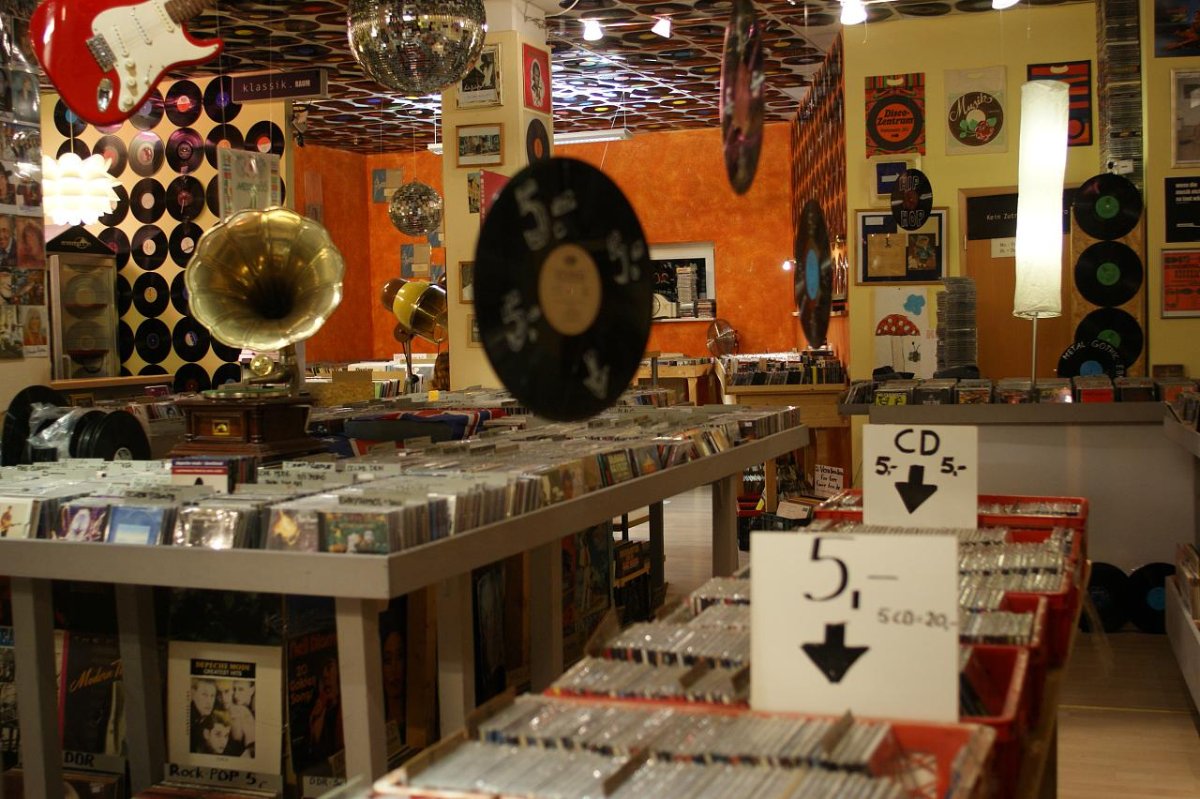
Title image: “Udagawacho, Shibuya, Japan” by Steve Allison (Wikimedia Commons, CC0). Record shop interior: “klang.KOMBINAT (record shop), Leipzig” by Hans Dinkelberg (Wikimedia Commons, CC BY 2.0).

Comments