Tokyo gets the attention, but Osaka has its own complete subculture ecosystem — and it’s more walkable. Nipponbashi Den Den Town is Osaka’s answer to Akihabara, and Amerikamura is where the city’s vintage clothing and street fashion scene lives. They’re about 20 minutes apart, which means you can realistically do both in a single day.
If you’ve already done Tokyo, this is the obvious second stop. In some ways it’s the better one: shops are more concentrated, crowds are thinner, and staff are noticeably more relaxed about browsing.
Information accurate as of August 2026. Opening hours and shop line-ups change; confirm before making a special trip.
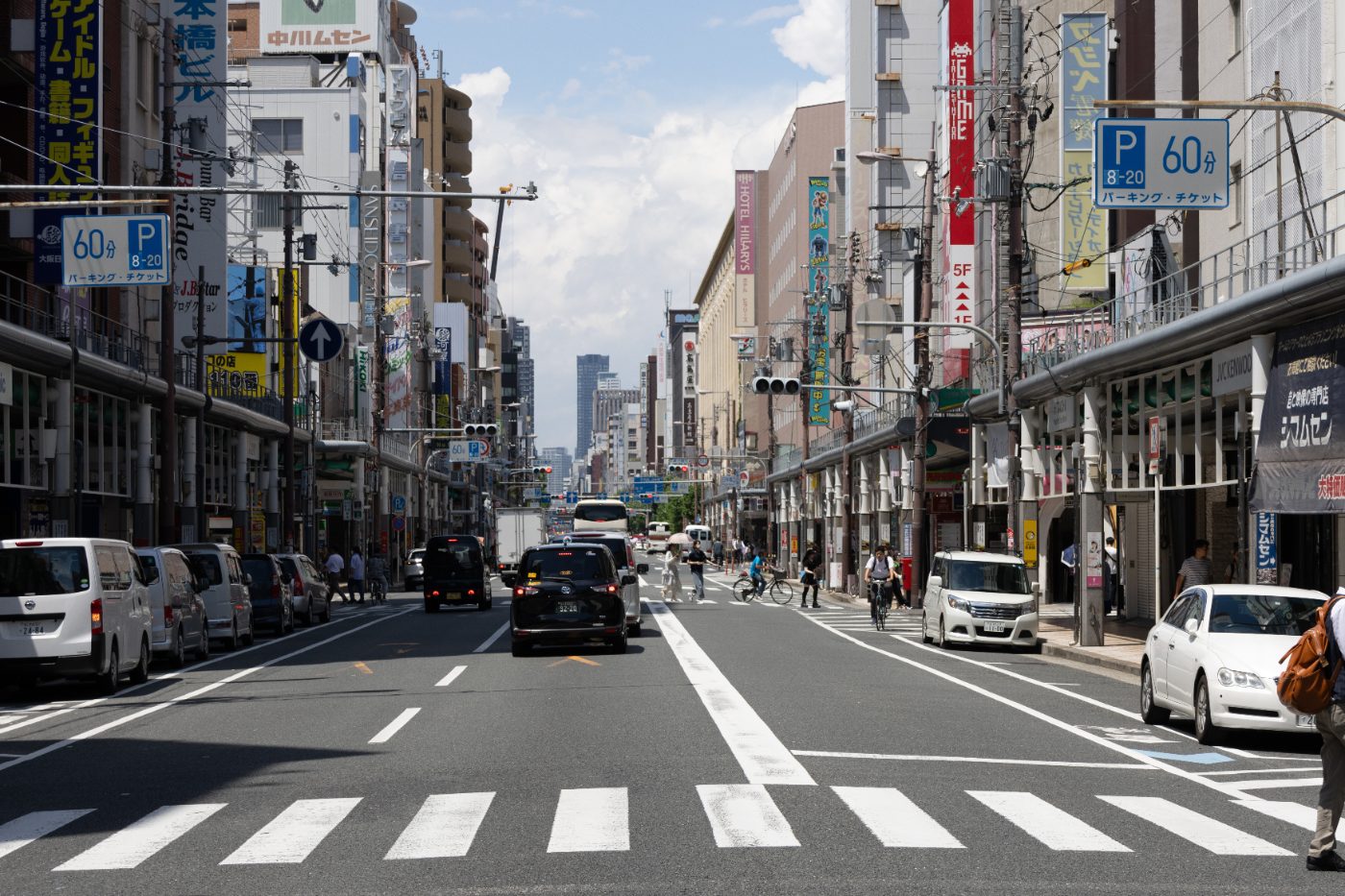
Understanding the layout of Den Den Town
This trips up a lot of first-timers. Den Den Town is really two parallel streets, and they are not the same:
- Sakaisuji Avenue — the main road between Ebisucho and Nippombashi stations, roughly 500m. Historically the electronics strip; now a mix of hobby shops, electronics and big stores.
- Ota Road (オタロード) — a parallel lane one block west, about 1km long. This is where the otaku shops actually cluster — doujinshi, figures, cosplay, maid cafes, trading cards. Well over 150 shops.
If you only walk Sakaisuji you’ll come away thinking Den Den Town is smaller than it is. Walk Ota Road.
Den Den Town: where to start
Mandarake Grand Chaos
Six floors, and the single best use of your time if you’re short on it. Manga, anime, retro games, idol merchandise, cosplay, doujinshi, special-interest magazines — vintage through to current. It’s the Osaka equivalent of Nakano Broadway’s Mandarake cluster, except stacked vertically in one building.
One thing to settle before you set out: Grand Chaos is not in Amerikamura. It left the Shinsaibashi building on 11 December 2020 and reopened the next day here in Den Den Town, in the former Joshin tax-free building. A surprising number of English-language guides still send readers to the old address.
Rough floor order, which does shift: 1F buy-back counter and toys, 2F dolls and US toys, 3F vintage manga, 4F discs, art books and subculture titles, 5F and 6F doujinshi, cosplay and trading cards.
- Access: about 6 minutes north on Sakaisuji Avenue from Ebisucho Station, exit 1B; roughly 12 minutes from Nippombashi or Namba
- Hours: 12:00–20:00 daily; the buy-back counter shuts at 19:30
- Tax-free: yes, from ¥5,000 before tax — bring the passport itself, not a photocopy
- Price range: Budget to High, depending on rarity
Super Potato Ota Road
The Osaka outpost of the retro game institution. The name to look for is the Retro-kan Ota Road store, and it sits on Ota Road rather than on Sakaisuji. Famicom, Super Famicom, PlayStation, Neo Geo, plus hardware, controllers and accessories.
If you have read about a multi-floor Super Potato with a Mario statue outside, that is the Akihabara branch in Tokyo. The Osaka shop is a smaller street-level affair, and the chain has been contracting here — the Suminoe branch closed on 25 May 2025, leaving Ota Road and Showacho as the two remaining stores in the city.
- Access: about 8 minutes from Nippombashi Station exit 4, or 8 minutes from Namba exit 3
- Hours: 11:00–20:00 on weekdays, from 10:00 at weekends and on holidays
- Price range: Budget to High
Cartridges here are mostly loose and region-locked to Japanese hardware, and the good stuff moves. If the title you came for has already gone, Buyee will bid on Japanese auction and marketplace listings on your behalf and forward the parcel.
Animate Osaka Nipponbashi
The reliable option for current releases: manga, light novels, character goods, and the seasonal collaboration merchandise that rotates constantly. Good for new items rather than second-hand hunting, and there is a Gratte dessert counter in-store if you need to sit down mid-crawl.
- Access: about 10 minutes on foot from Namba; also close to Nippombashi on the Sakaisuji Line
- Hours: 11:00–20:00 on weekdays, from 10:00 at weekends and on holidays
- Tax-free: yes
- Price range: Budget to Mid
Jungle
A specialist worth seeking out on Ota Road for figures, robot toys and second-hand collectibles, with a deep back-catalogue that rewards patient digging. Less polished than the big chains, which is rather the point. New and used model kits, tools and paints too, so it doubles as the restock stop if you build.
- Address: 3-4-16 Nipponbashi, Naniwa-ku
- Hours: 12:00–20:00 on weekdays, from 11:00 at weekends and on holidays
- Price range: Budget to High
Kaiyodo Hobby Lobby Osaka
The newest reason to walk to the southern end of the district, and one no older guide will mention. Kaiyodo — the sculpting studio behind a large share of Japan’s high-end figures and capsule toys — opened its own directly run shop on 17 July 2026, near Tsutenkaku in Shinsekai. Alongside figures, model kits and capsule toys there is a gallery of original sculpted work and a schedule of modelling and painting workshops, which the chain stores do not offer.
It is a short walk from Ebisucho Station, so it slots onto the end of a Sakaisuji crawl rather than needing a trip of its own.
- Address: 2-1-22 Ebisuhigashi, Naniwa-ku, 1F
- Hours: 11:00–19:00
- Price range: Mid to High
Amerikamura: Osaka’s vintage district
Known locally as Amemura, this is a compact grid of streets west of Shinsaibashi, about 3 minutes on foot from Shinsaibashi Station and 7–8 from Namba. The name dates to the 1960s, when shops here started importing American clothing and used records — that DNA is still visible.
Compared with Tokyo: it’s denser than Koenji and less polished than Shimokitazawa. Prices sit somewhere in between. The strong suit is American vintage and streetwear rather than the Japanese designer archive pieces you’d hunt in Tokyo.
Kinji (BIGSTEP)
Two large floors inside the Shinsaibashi BIGSTEP complex, and the volume is genuinely overwhelming — racks and piles of clothing, kimono, accessories. This is a dig-for-an-hour shop, not a browse-for-ten-minutes shop.
Officially it is the KINJI BIGSTEP store. Kinji runs eight branches around Osaka and there is no separate street-level shop in Amemura, so if a guide sends you to “Kinji Amemura” this is the one it means.
- Address: BIGSTEP 2F, 1-6-14 Nishishinsaibashi, Chuo-ku, Osaka
- Hours: 11:00–20:00; the buy-back counter takes items 12:00–18:45
- Price range: Budget to Mid
Kindal Shinsaibashi
Three floors, each with a different focus, running from streetwear up to high-end designer resale. If you are looking for labels rather than volume, start here instead of Kinji. It faces Sankaku Park directly, which makes it the easiest shop in Amemura to find.
- Address: 2-18-7 Nishishinsaibashi, Chuo-ku, Osaka (2F–4F)
- Access: about 5 minutes from Shinsaibashi Station exit 7
- Hours: 11:00–20:00, no regular closing day
- Payment: credit cards plus PayPay, Alipay, WeChat Pay and Rakuten Pay — one of the few shops here that states this openly
- Price range: Mid to High
Pigsty Amemura
Proper vintage — 1930s through 1980s American pieces alongside more everyday second-hand stock, plus antiques, jewellery and sneakers. The place to go if you want something with actual age to it.
Finding it defeats people: the shop is on the third floor, and the landmark is the suit of armour standing on the ground floor of the building. Note also that Pigsty runs a second Amemura shop, the “a to z” store at 1-9-16, with different stock — they are not interchangeable.
- Address: 1-7-14 Nishishinsaibashi, Chuo-ku, Osaka, 3F
- Hours: 12:00–20:00, open daily
- Payment: cash, credit cards and electronic money
- Price range: Mid to High
Vintage sizing is the usual trap here — American cuts from the 1970s run very differently to modern ones, and there are no returns. If you find a label you like and want to keep hunting it after you fly home, Buyee can buy from Japanese second-hand marketplaces and forward the parcel for you.
What changed in 2025 and 2026
Both districts have moved around more than usual over the last eighteen months, and most English-language guides still describe the old layout.
- Shinsaibashi OPA closed for good on 12 January 2026 after 31 years. Demolition of the building runs from June 2026 to March 2028, so expect hoarding and construction on that block — two minutes from Amemura — for the whole of your visit.
- HMV record shop Shinsaibashi, previously inside OPA, reopened on 13 March 2026 as a standalone store in Daimaru Shinsaibashi’s White Avenue. HMV&BOOKS moved separately to Namba Marui.
- Shinsaibashi PARCO ran its first large-scale renewal in phases through 2026. The arrival that matters for this crowd is MEDICOM TOY WEST on B1F, open since 11 April 2026.
- Toranoana no longer has its own Den Den Town shop. Its women’s doujinshi floor now operates inside Suruga-ya at 4-14-1 Nipponbashi, 12:00–22:00.
- Nipponbashi Street Festa, the cosplay parade that closes the main street, ran on 17 May 2026. It is normally a Sunday in May — worth planning around if you want to see it, and worth avoiding if you came to shop.
On the record side, second-hand is what Amemura does well; if you are after new Japanese pressings with the obi strip rather than used copies, CDJapan ships domestic editions overseas directly.
Doing both in one day
They’re close enough that this is easy, and the order matters:
- Start in Den Den Town in the morning. Hobby shops open earlier (many from 10:00–11:00) than vintage shops, which often don’t open until noon.
- Work north from Ebisucho along Ota Road, then cut across to Sakaisuji.
- Walk or take one stop to Namba, then on to Amerikamura for the afternoon, when the vintage shops are all open.
- Finish in Amemura or Shinsaibashi in the evening — that’s where the food and bars are.
Bring cash, but not because everywhere is cash-only — that claim gets repeated far more confidently than the evidence supports. The larger shops take cards: Mandarake, Pigsty and Kindal all do, and Kindal takes the QR wallets as well. It is the small independent used-game, doujinshi and vintage shops where you cannot assume it.
The bigger change to budget for is tax-free. From 1 November 2026 Japan switches to a refund system. You pay the full tax-included price at the register, and the consumption tax comes back to you only after Customs confirms at your departure airport that the goods are leaving with you. The split between general goods and consumables disappears, the ¥5,000 minimum still applies per shop per day, and you have 90 days from purchase to clear Customs.
Two catches bite in these districts in particular. If any single item in a transaction fails verification, the entire receipt loses its exemption. And the option to have tax-free purchases shipped home separately was scrapped on 31 March 2025, so a large-scale figure or a boxed console has to fit in your luggage. See our guide to the tax-free changes for the full picture.
Want a guided introduction to the area? Klook’s Osaka experiences and tours cover the wider Namba and Shinsaibashi area. And if you spot something you can’t carry home, Buyee can buy from Japanese stores and ship it on to you.
Planning to combine this with other stops? Our route and budget planner tool can help you work out an order and a rough budget.