Japan still runs on cash more than most visitors expect. Second-hand shops, small vintage boutiques, standing bars and older sento are frequently cash-only, and from November 2026 you’ll also be paying consumption tax up front and claiming it back at the airport. So the question of how you get yen matters more here than in most countries.
This guide deliberately doesn’t publish exchange rates. Rates move daily, and any table of numbers would be wrong within a week. What doesn’t change is how the fees are structured — and once you can read that, you can judge any counter or card for yourself.
Information accurate as of August 2026. Fees and services change; confirm current terms with your own bank and card issuer before you travel. This is general information, not financial advice.
The one thing worth understanding: the spread
Most exchange counters advertise “no commission” or “0% fee.” This is usually true and usually irrelevant, because that isn’t where they make their money.
The real cost is the spread: the gap between the mid-market rate (the true rate you’d see on Google or a currency app) and the rate you’re actually offered. A counter charging zero commission but a 6% spread is more expensive than one charging a small flat fee on a 1% spread.
How to check in ten seconds: look up the mid-market rate on your phone before you approach the counter. Compare it to their board rate. The difference is what you’re paying, regardless of what the sign says about commission.
Your four realistic options
1. Airport exchange counters
Convenient, open when you land, and staffed by people used to foreign travellers. The trade-off is that airport counters generally carry wider spreads than city ones — you’re paying for the location.
Sensible use: change a small amount for your first day (train fare, food, a taxi if something goes wrong), then sort out the rest in the city. Arriving with zero yen is a genuinely bad idea; changing your entire budget at the airport is just expensive.
2. Withdrawing from an ATM
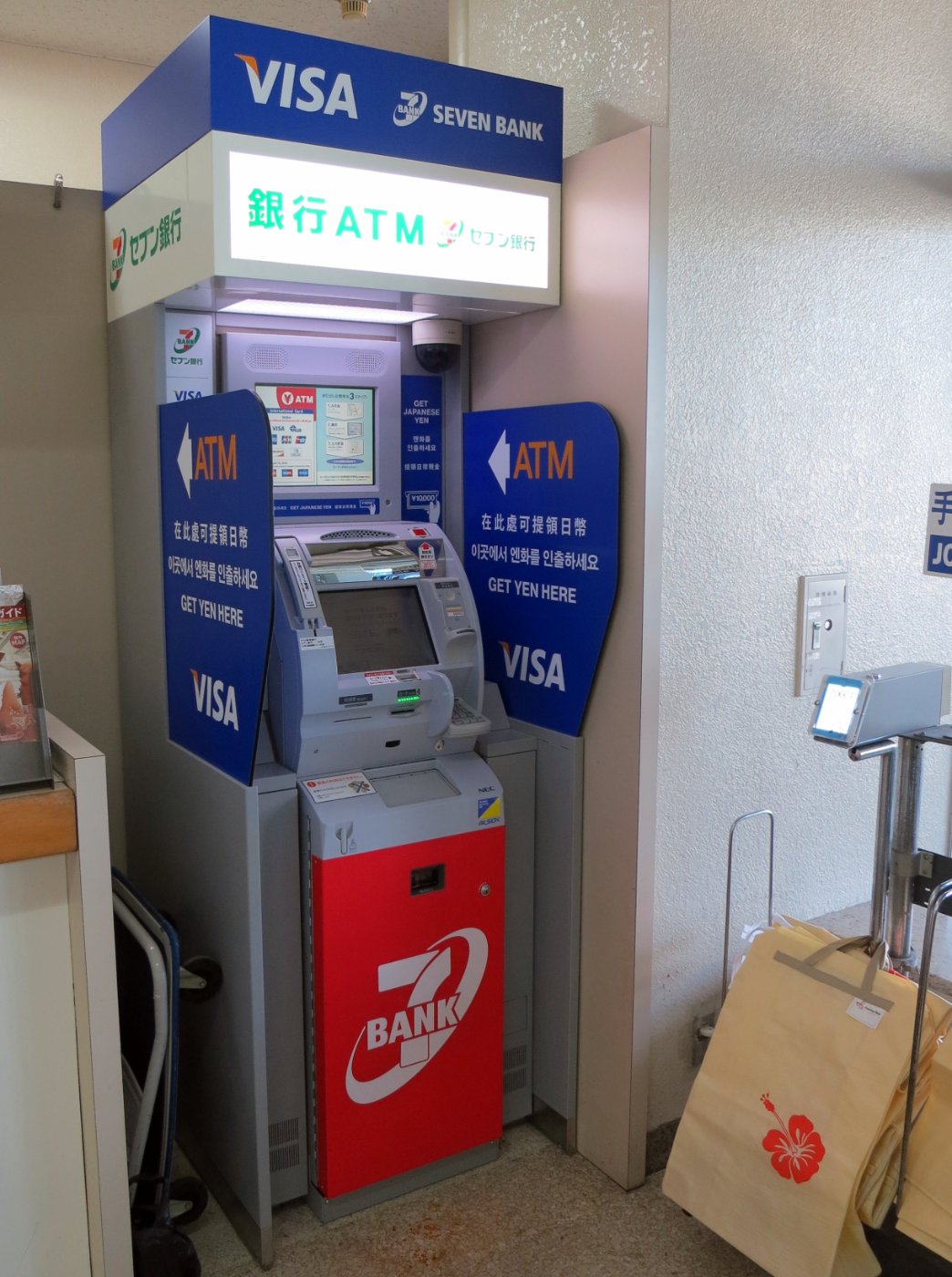
For most visitors this is the practical default, because you get something close to your card network’s rate rather than a retail counter rate. The catch in Japan is that many domestic bank ATMs simply don’t accept foreign cards. Two networks reliably do:
- Seven Bank (inside 7-Eleven, 20,000+ locations). Mastercard, Maestro and Cirrus currently incur no Seven Bank fee; Visa and Visa Electron are charged ¥110 under ¥10,000 and ¥220 at ¥10,000 or above. Multilingual interface, typically 00:05–23:50.
- Japan Post Bank (post offices). No fee during business hours, ¥110 outside them. Single-withdrawal limit of ¥50,000.
- Backups: Lawson (¥110) and Aeon Bank (¥75).
Don’t forget your own bank’s charge. Whatever the Japanese ATM charges, your home bank usually adds a foreign-ATM fee (often the equivalent of $2–5) plus a foreign transaction fee. Because those are partly fixed, fewer, larger withdrawals usually cost less overall than many small ones — balanced against how much cash you’re comfortable carrying.
3. City exchange counters
Independent exchange shops cluster around major stations and tourist districts, and rates vary noticeably between them — sometimes on the same street. Long-established operators such as Daikokuya are generally better regarded than the machines and pop-up counters aimed purely at tourist footfall.
Worth knowing: some counters quote a better rate for larger amounts, and most give a worse rate for coins than notes. If you’re changing a meaningful sum, it’s reasonable to check two or three nearby counters before committing.
4. Multi-currency cards
Cards from providers like Wise or Revolut let you hold and convert currencies in-app, usually at or near the mid-market rate with a stated conversion fee. They work well in Japan for card payments and ATM withdrawals, and they make the cost visible instead of buried in a spread.
The caveat: they don’t remove Japan’s cash problem. Plenty of the shops in our subculture guides don’t take cards at all, so you’ll still be withdrawing yen — a multi-currency card just tends to make that withdrawal cheaper.
The mistake that quietly costs the most
When you pay by card or use an ATM, you may be asked whether you want to be charged in yen or in your home currency. Being offered your own currency feels helpful. It usually isn’t.
This is dynamic currency conversion (DCC). Choosing your home currency hands the conversion to the merchant’s or ATM operator’s provider, who sets the rate — commonly the interbank rate marked up by around 4%. Worse, some card issuers still apply their own foreign transaction fee on top, so you can end up paying twice.
Always choose to pay in Japanese yen. You’ll still pay your own card’s rate and fees, but those terms are generally better than what a DCC provider offers. This single habit tends to save more than agonising over which exchange counter to use.
A practical approach
- Arrive with a small amount of yen, or change a little at the airport — enough for a day.
- Withdraw the bulk from a Seven Bank or Japan Post ATM once you’re in the city, in fewer and larger amounts.
- Always decline the home-currency option and pay in yen.
- Carry more cash than feels normal on shopping days. Second-hand and independent shops are often cash-only.
- Keep small change — coin lockers, older sento and some vending machines still want ¥100 coins.
Working out how much you’ll actually need? Our route and budget planner estimates transport, shopping and lodging together, and our Japan travel budget guide covers what things cost day to day.
Money sorted? The rest of the first-trip admin — visas, Visit Japan Web, IC cards and eSIMs — is in our survival guide, and the unwritten rules that trip people up are in our etiquette guide.


Comments