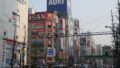
Akihabara gets the card-shopping traffic. Ikebukuro has more shops. There are over thirty trading card stores inside a few blocks of the station’s east side, and almost none of them are at street level — they are on the fourth, sixth and seventh floors of ordinary office buildings, behind lift doors with a paper sign taped beside them. If you walk Sunshine 60-dori looking for shopfronts, you will conclude there is nothing here.
This guide is four shops, chosen because they answer four different questions, plus the one place every visitor asks about — the Pokémon Center — which reopened on 24 August 2026 after five months closed, and which you now need a ticket to enter.
- Ikebukuro’s card district is vertical, not a street
- Pokémon Center MEGA TOKYO reopened on 24 August 2026 — and you need a ticket
- 1. Dragon Star Ikebukuro — 116 seats, the biggest room in the district
- 2. Hobby Station Ikebukuro Main Store — half the floor is table space
- 3. BIG MAGIC Ikebukuro — where the singles buyers go
- 4. Yellow Submarine Ikebukuro GAME SHOP — cards, board games, and a table you pay for
- The opening-hours trap: almost nothing here opens in the morning
- What the listing sites get wrong
- Tax-free, and what changes on 1 November 2026
- Getting your cards home
- Nearby
Ikebukuro’s card district is vertical, not a street
Every shop below sits in Higashi-Ikebukuro 1-chome, the block of buildings between the station’s east exit and Sunshine City. Walking end to end takes about seven minutes. What makes it hard is that the shops are stacked: Dragon Star is on 4F, Yellow Submarine and BIG MAGIC are on 6F, Hobby Station is on 7F. Nothing is visible from the pavement.
Practical consequence: work from building addresses, not from a map pin dropped on a street. Two of the shops below are in buildings that also contain unrelated businesses on every other floor, and at least one popular listing site has the wrong building for BIG MAGIC entirely (more on that below).
You will be checking floor numbers and shop hours on your phone the whole time you are in this district, and several of these buildings have poor signal in the lift lobbies. If you have not sorted data yet, a prepaid Japanese eSIM installs before you fly and connects the moment you land — cheaper than airport rental and one less counter to find.
Pokémon Center MEGA TOKYO reopened on 24 August 2026 — and you need a ticket
This is the single thing most English guides currently have wrong, because it changed yesterday relative to this update.
Pokémon Center MEGA TOKYO, on the 2nd floor of Sunshine City alpa, closed on 26 March 2026 following an incident at the store, together with the adjoining Pikachu Sweets. It stayed shut for five months. The Pokémon Company originally said it would reopen around September; on 27 July it brought the date forward, and the store reopened on Monday 24 August 2026.
Entry is now controlled. For the reopening period the store is issuing timed numbered tickets from the entrance, with distribution starting around 09:00 and moving earlier or later depending on the queue. The rules are strict and worth knowing before you build a morning around it:
- One ticket per person, collected in person. No collecting for friends.
- You cannot join a queue partway through for someone already in it.
- Tickets are valid on the day of issue only, and the time slot cannot be changed or reissued.
- The store has said the system may change day to day depending on conditions.
Listed hours are 10:00–20:00, seven days. The address is Sunshine City alpa 2F, 3-1-2 Higashi-Ikebukuro — about 8 minutes on foot from Ikebukuro Station, or 3 minutes from Higashi-Ikebukuro on the Yurakucho line. If you are coming specifically for this, check the store’s own notice page the night before rather than a third-party listing, because the entry rules are being adjusted week by week.
One thing to be clear about: the Pokémon Center sells sealed product and merchandise. It is not where you buy singles. For that, you want the four below.
1. Dragon Star Ikebukuro — 116 seats, the biggest room in the district
Dragon Star’s Ikebukuro branch is the chain’s flagship and it is built around play space: 116 seats, which is more than any other shop in the area and more than most shops in Akihabara. If your reason for coming to Tokyo includes sitting down and playing against someone, this is the default answer.
The counter carries essentially everything current — Pokémon, Yu-Gi-Oh OCG and Rush Duel, Duel Masters, Vanguard, Digimon, Union Arena, One Piece, the Gundam card game, Dragon Ball, and Lorcana. The singles walls are organised by title and priced individually, so you can browse without asking.
Seiko Sunshine Building XII, 4F, 1-30-6 Higashi-Ikebukuro. About 5 minutes from the JR east exit. Weekdays 13:00–21:00, Saturday 10:00–21:00, Sunday and holidays 10:00–20:00. Note the weekday opening — 13:00, not midday.
2. Hobby Station Ikebukuro Main Store — half the floor is table space
Hobby Station’s main Ikebukuro branch gives roughly half its floor area to a 70-seat duel space, which is unusual for a shop this central and makes it the most comfortable place in the district to actually sit for an hour. It runs sanctioned events for most major titles, so on a weekend afternoon expect the room to be busy rather than empty.
Stock skews toward the current competitive titles plus hololive and Union Arena. If you are selling as well as buying, note that the buy counter closes two hours before the shop does — a detail that catches people who arrive at 19:00 on a weekday expecting to trade.
Sankee Building 7F, 1-22-5 Higashi-Ikebukuro. Exit 35 from the station’s east side. Weekdays 12:00–21:00, weekends and holidays 11:00–20:00, open every day of the year.
3. BIG MAGIC Ikebukuro — where the singles buyers go
BIG MAGIC is the shop to walk into with a list. It is built for buying specific cards rather than opening packs: Magic: The Gathering first, then Yu-Gi-Oh and Rush Duel, Weiss Schwarz, Pokémon, Duel Masters, the Gundam card game, Eiketsu Taisen and Dragon Ball Fusion World. Prices are marked and the staff are used to being handed a written list, which removes most of the language problem.
It also has the district’s one late night: Friday until 22:00. Everything else in this guide is shut by 21:00 at the latest.
Kindai BLD No. 11, 6F, 1-22-13 Higashi-Ikebukuro. Monday to Thursday 12:00–20:00, Friday 12:00–22:00, weekends and holidays 11:00–20:00. Phone enquiries about prices are not accepted, so do not plan to call ahead about stock.
4. Yellow Submarine Ikebukuro GAME SHOP — cards, board games, and a table you pay for
Yellow Submarine is the one non-specialist on this list and the more interesting shop for it. Alongside Magic, Yu-Gi-Oh and Pokémon it carries board games, TRPGs, dice and simulation games — the closest thing Ikebukuro has to a general hobby shop, and the right stop if you are shopping for someone whose interest is games rather than one specific card game.
Its duel room is small — 24 seats — and unlike the others it is not free. You either buy something or pay to sit: ¥200 on weekdays, ¥500 at weekends and on holidays, waived if you spend at least that much in the shop. This is normal in Japan and not a tourist charge, but it surprises people.
Otowa Building 6F, 1-15-2 Higashi-Ikebukuro. Monday to Thursday 12:00–20:00, Friday and Saturday 12:00–21:00, Sunday and holidays 11:00–19:00. Open every day. That Sunday 19:00 close is the earliest in the district and the single most common way to arrive at a locked door.
The opening-hours trap: almost nothing here opens in the morning
Ikebukuro’s card shops run on player hours, not shopper hours. On a weekday, three of the four shops above open at 12:00 and Dragon Star does not open until 13:00. If you have a morning free and a flight in the evening, this district is the wrong plan — you will spend it looking at shutters.
The workable shapes are:
- Weekday afternoon — arrive at 13:00, everything is open, the play rooms are quiet enough to browse the singles walls without queueing.
- Saturday morning — Dragon Star opens at 10:00 and Hobby Station at 11:00, so an early start works, but the rooms fill by early afternoon.
- Sunday — start earliest, finish earliest. Yellow Submarine closes at 19:00 and Dragon Star at 20:00.
If you only have one hour, do Dragon Star and Hobby Station: they are a four-minute walk apart and between them cover every current title.
What the listing sites get wrong
Ikebukuro’s card shops are covered almost entirely by Japanese aggregator sites that copy each other, and the copies drift. Checking each shop’s own site against the popular round-ups turned up three errors worth knowing about, because they are the kind that waste an afternoon:
- BIG MAGIC’s address is wrong on at least one widely-shared list, which places it in a different building several blocks away. The shop’s own site gives Kindai BLD No. 11, 6F.
- Yellow Submarine’s hours are wrong on the same list, which shows a Monday closing day the shop does not have and a 19:00 weekday close instead of 20:00. Yellow Submarine is open every day.
- Seat counts are consistently understated. Dragon Star is listed as “over 100 seats”; the shop says 116. Hobby Station is listed at 66; the shop says 70.
The general rule for this district: trust the shop’s own page for hours and address, and treat everything else as a starting point.
Tax-free, and what changes on 1 November 2026
Cards are ordinary consumer goods, so they qualify for tax-free purchase — including used and single cards, which are not excluded, despite what a lot of guides claim. The real constraint is that the shop has to be a registered tax-free retailer, and most independent card shops are not. The chains are more likely to be than the one-room specialists, but assume you are paying tax unless you see the sign.
From 1 November 2026 Japan switches to a refund system: you pay the full price including tax at the till, then have your purchases confirmed by customs at the airport and receive the refund there. Goods must be with you as carry-on — the old option of shipping them separately ended in March 2025. For cards this is easy, but budget the extra airport time.
Getting your cards home
Bring sleeves and a hard case with you, or buy them at the first shop you enter — every shop on this list sells supplies, and it is much cheaper than replacing a bent card. Japanese shops sleeve high-value singles as standard but will hand you cheaper cards loose in a small bag.
Cards travel badly in checked luggage and well in a backpack. If you buy sealed boxes, weigh your case before you get to the airport — a display box of a current Pokémon set is heavier than it looks, and two of them will move most people into excess baggage.
Nearby
The card block sits directly between the station and Otome Road, so it combines naturally with the doujinshi and BL shops five minutes north — see our Ikebukuro Otome Road guide. Ikebukuro also has three record shops worth an hour — one of which moved to a new building on 26 August 2026 — in our Ikebukuro record shop guide. If you are comparing districts before committing an afternoon, our Akihabara card shop guide covers the four best stops there; Akihabara has the bigger single-building density, Ikebukuro has more shops and more table space. For older stock — Carddass, Bikkuriman and pre-2000 Pokémon — see our Nakano Broadway card shop guide. For the tax rules in detail, see our guide to Japan’s tax-free changes in November 2026. If the card shops are shut by the time you finish, the Ikebukuro arcade guide covers the four game centres that stay open — most until at least eleven, two until midnight. Ikebukuro is also the easiest of these districts to sleep in, with one hotel connected directly to Sunshine City — where to stay in Tokyo has the four verified options here, and why the accommodation tax rise you may have read about does not start until April 2027.