Information accurate as of August 2026. Nakano Broadway has around 300 tenants and they change constantly — confirm before making a special trip. Nakano Station is also mid-redevelopment; see the access notes below.
Nakano Broadway is a 1966 shopping complex four minutes from Shinjuku that became, almost by accident, the most concentrated collectors’ market in Japan. Akihabara sells you what is new. Broadway sells you what is out of print: production cels from shows that finished thirty years ago, rubber-eraser figures from 1985, film posters, idol bromides, and manga first editions — stacked in roughly 300 small units across four floors, with 220 apartments sitting on top of them.
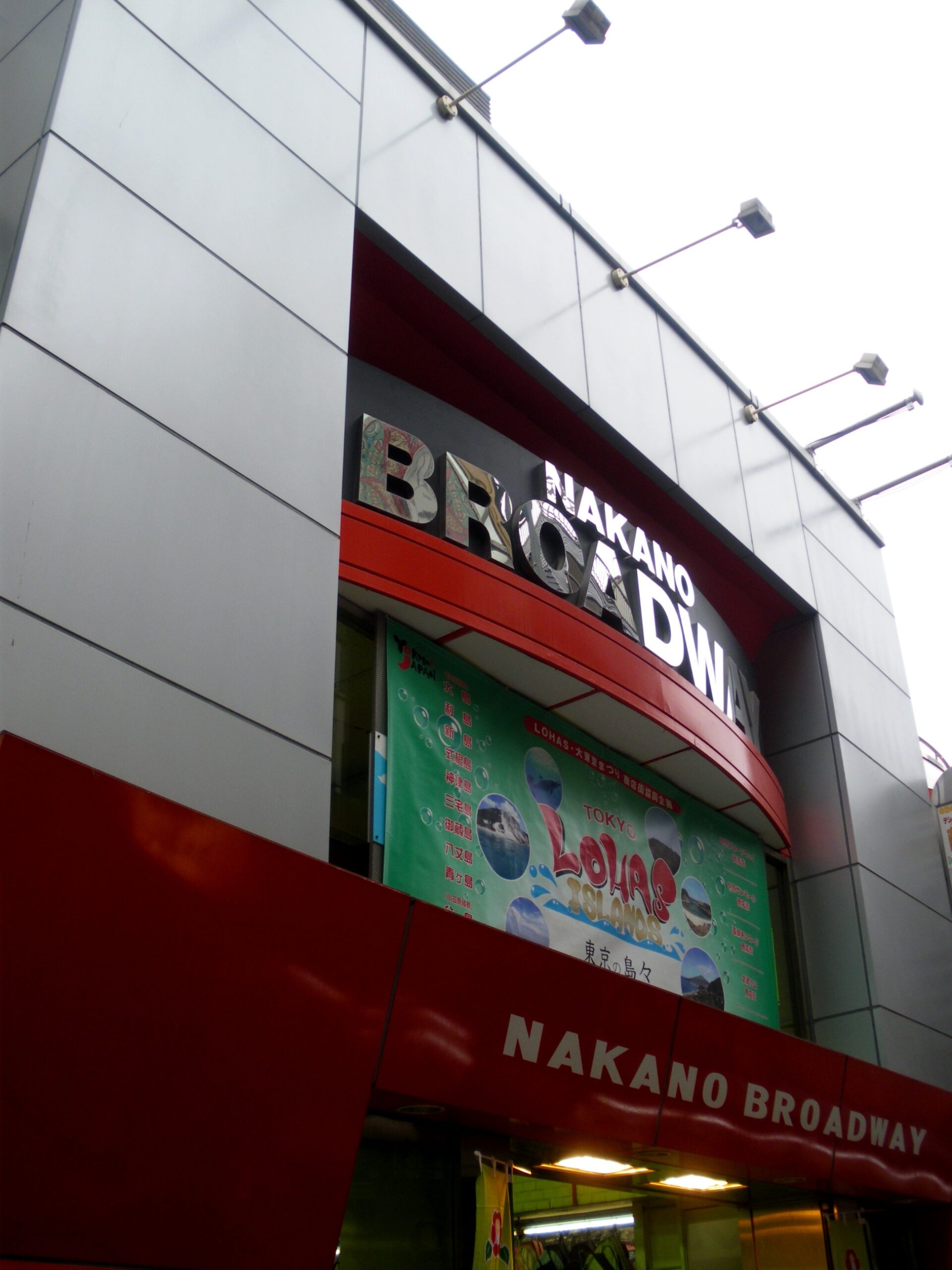
It is also genuinely confusing on a first visit. Two of the five public floors are ordinary neighbourhood shops, half the doors on the top floor are not shops at all, and nothing opens when you expect. This guide covers getting there, what is on each floor, and the shops worth your hours.
How to get to Nakano Broadway
Nakano Station is served by the JR Chuo Line Rapid, the JR Chuo–Sobu Local, and the Tokyo Metro Tozai Line, which terminates here.
- From Shinjuku — direct, no transfer. 4 minutes on the Chuo Rapid, 7 on the Chuo–Sobu Local. About ¥200.
- From Shibuya — change at Shinjuku; 14–19 minutes, ¥210. There is no direct service.
A note if you have read about the weekend rapid trap: it does not apply here. The Chuo Rapid skips Koenji, Asagaya and Nishi-Ogikubo at weekends — but those are all west of Nakano. Nakano keeps full rapid service every day of the week.
From the station: take the north exit, not the south. Directly opposite you is the covered Sun Mall arcade. Walk straight up it for about three minutes — there are no turns, and the arcade dead-ends into the Broadway entrance. Five minutes door to door from the ticket gates, under cover the whole way.
Ignore older guides that tell you to look for the white wedge-shaped Sun Plaza. It closed to the public in 2023 and demolition was confirmed in March 2026; it is no longer a landmark. Nakano Station is also being rebuilt — a new west ticket gate and an 80-metre north–south passage open on 6 December 2026, and Atre Nakano, a five-floor station complex with around seventy shops, opens on 9 December. Neither changes your route: the new gate faces west, towards the park, while Sun Mall and Broadway stay straight out of the existing north exit. The north exit plaza itself is a construction site until 2029 and the pedestrian decks around it until 2030.
This page is about the building. For the rest of the district — the record shop on the south side of the station, the two drinking alleys on opposite exits, and how Nakano fits into a day with Akihabara or Koenji — see our Nakano district guide.
Why the building is like this
Nakano Broadway opened in 1966 as something else entirely: shops underneath and apartments above, sold at the time as the finest development of its kind in the East. Around 220 flats occupy the upper floors and people still live in them. The commercial floors are B1 to 4F — everything above that is somebody’s home, which is why the lifts are full of residents and why the building has a caretaker rather than a mall management office.
The 31-metre height limit of the era explains the rest of it. The developer took the maximum number of storeys the cap allowed and the ceilings came down to fit. The low, pressing feel of the upper corridors is a 1960s planning rule, not a design decision.
The most consequential fact is the one you cannot see: the shop units were sold off individually rather than leased by a single landlord. There is no operator setting hours. Every unit is its own business with its own opening time, its own closing day and its own rules about photographs and cards — which is why nothing in this building behaves consistently, and why any floor directory more than a year old is already wrong. The figure usually quoted is around 300 shops; no official count is published and the turnover is constant.
One of the early residents was Yukio Aoshima, the comic novelist and television writer who later became Governor of Tokyo.
What is on each floor
This is the single most useful thing to know before you walk in, because two of the five public floors are not what you came for.
The single most useful thing to know about this building: the escalator skips the second floor. The two up escalators run 1F straight to 3F. There is no escalator up to 4F either, and — the part that catches people out at the end of the day — no down escalator anywhere above ground level. Stairs or the lift are the only way to 2F, to 4F, and back down from any of it. Below ground the arrangement is mirrored: three escalators run down to B1 and none come back up. Because almost nobody works this out on arrival, most visitors never see half of the Mandarake branches, or Lashinbang at all.
- B1 — skip it, except for one thing. A genuine local market: greengrocers, delicatessen, cheap fashion, fortune tellers along a short basement alley (占い小路), drugstores and hundred-yen shops. Sharing the floor is a full Seiyu supermarket (西友中野店), 10:00 to 23:00, open every day of the year — the only part of Broadway still trading after eight in the evening. The exception you came for is Daily Chico, below.
- 1F — walk through it, but do not judge the building by it. Bags, shoes, a pharmacy, phone repair: ordinary neighbourhood retail, and the floor you arrive on from Sun Mall. It is the reason a share of visitors decide Broadway is overrated and leave. Keep going and this floor also holds Junk World (used PCs and electronics), GEO Mobile (used phones and tablets, 11:00–21:00) and Fire Kids vintage clothing, alongside Mon, the smallest Mandarake branch in the building.
- 2F — the first serious floor. Around fifteen Mandarake branches plus Robot Robot and the Zingaro cafe, interleaved with hair salons and clothing shops. All three halls of Lashinbang are here too — Figure & Hobby, Audio Visual and Outlet — and they open at 11:00, a full hour before Mandarake, closing at 20:00. That hour from 11:00 to 12:00 is the only slot in the day when any part of the hobby floors is worth walking. Lashinbang’s buy-back counter sits in the Figure & Hobby hall and stops taking items at 19:00.
- 3F — the densest floor, and where to spend most of your time. Mandarake’s main store, twenty-odd vintage watch dealers, TACO ché, Hakaba no Garou, Fujiya Avic, Euro Surplus.
- 4F — the connoisseur floor. The deep-specialist Mandarake branches. Quiet, maze-like, and half the doors are offices, warehouses or clinics rather than shops. Rewarding if you know what you are after, baffling if you do not.
- 5F and above — private apartments. No public access, whatever the internet tells you about the rooftop.
Opening hours are the thing that catches people out. There are no building-wide hours — each tenant sets its own — but every Mandarake branch opens at 12:00 and closes at 20:00, seven days a week. Arriving at 10:00 gets you a floor of shuttered units and a soft serve. There is no weekly closing day for the building, but it shuts completely once a year for electrical inspection, on the third Wednesday of February, Mandarake included. The B1 market arcade also closes on the third Wednesday of every month — the Seiyu does not, and trades through. Wednesday is still the weakest day to come: the anchors all trade, but a noticeable share of the one-room shops that make the building interesting — Fire Kids and shop MECANO among them — take it off.
One thing to understand before you start climbing: Broadway stock is one-off. The building lists almost none of it online, the cases are filled from private collections and consignment, and what is in front of you today is genuinely gone next week. If you get home and realise you should have bought it, the Japanese secondhand market is where it resurfaces: Buyee bids and buys on Yahoo! Auctions and Mercari on your behalf and forwards the parcel abroad. For new domestic-press CDs, Blu-rays and artbooks, CDJapan ships direct.
Mandarake: which branch for what
Mandarake is not one shop here — it is around twenty-five separately branded units scattered across three floors, each with its own specialism. Treating it as a single store is the most common way to waste an afternoon. These are the ones that matter.
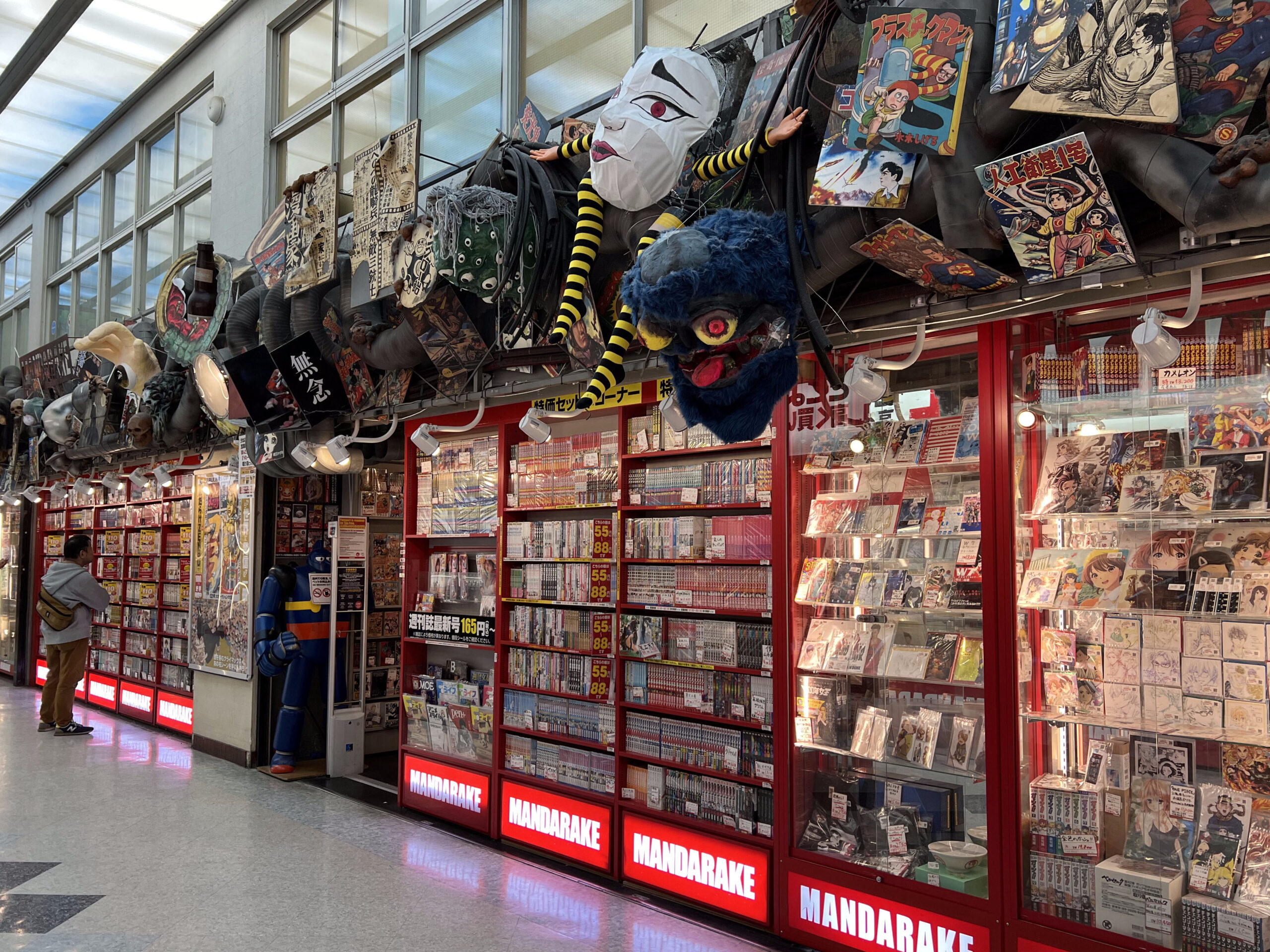
Main Store (Honten) — 3F
The original 1980 shop and the manga engine room: complete runs, first-edition tankobon, pre-war and Showa magazines, and a large doujinshi section. If you want a specific out-of-print volume rather than a browse, start here. The adjoining Honten 2 holds the adult-comics showcase.
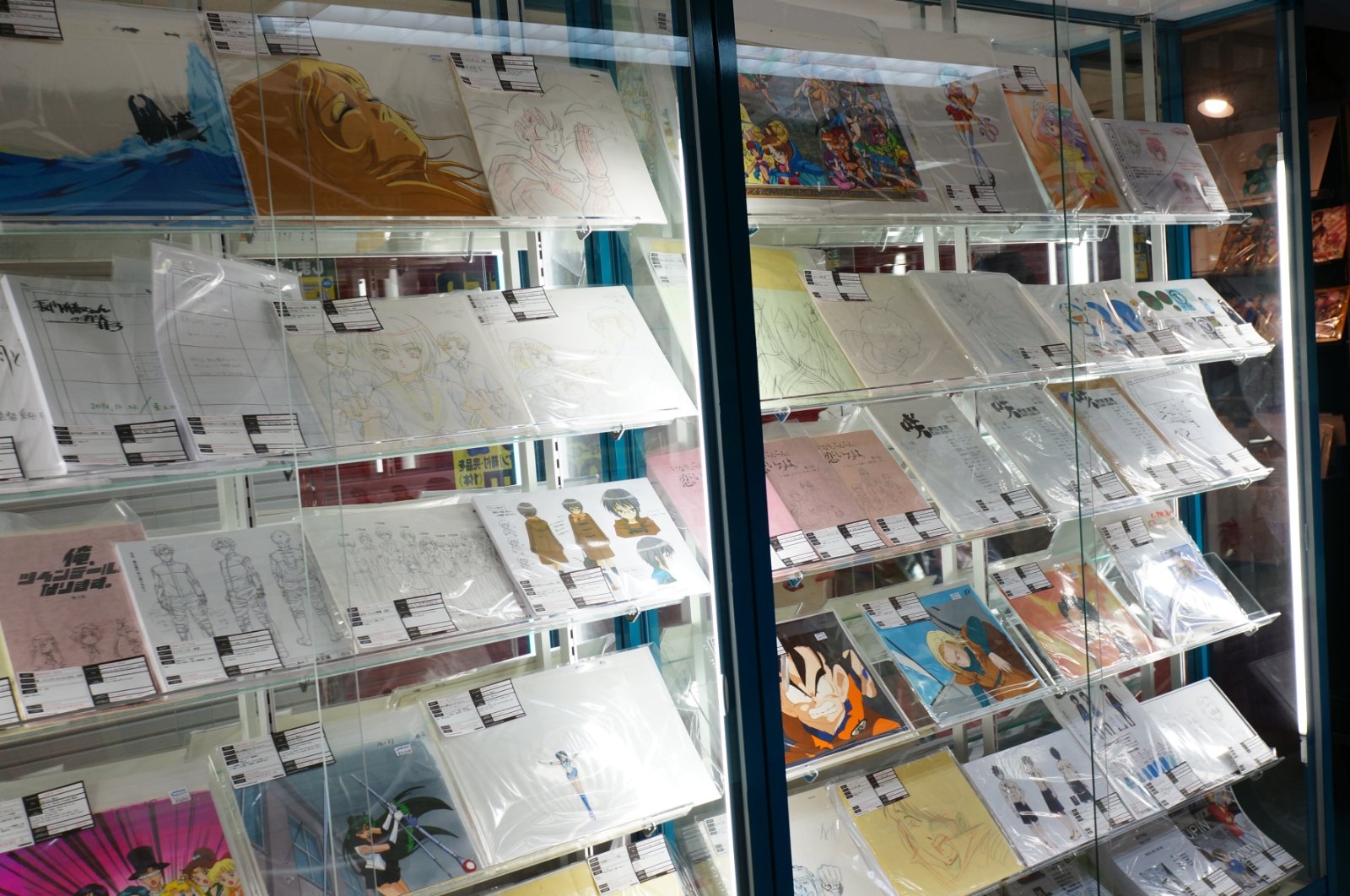
Anime-kan — 4F
Hand-painted production cels, genga and douga, character model sheets, colour-correction sheets, studio scripts. Physical artefacts from the pre-digital era, at a depth that simply does not exist in Akihabara. For animation-history collectors this is the most important room in the building.
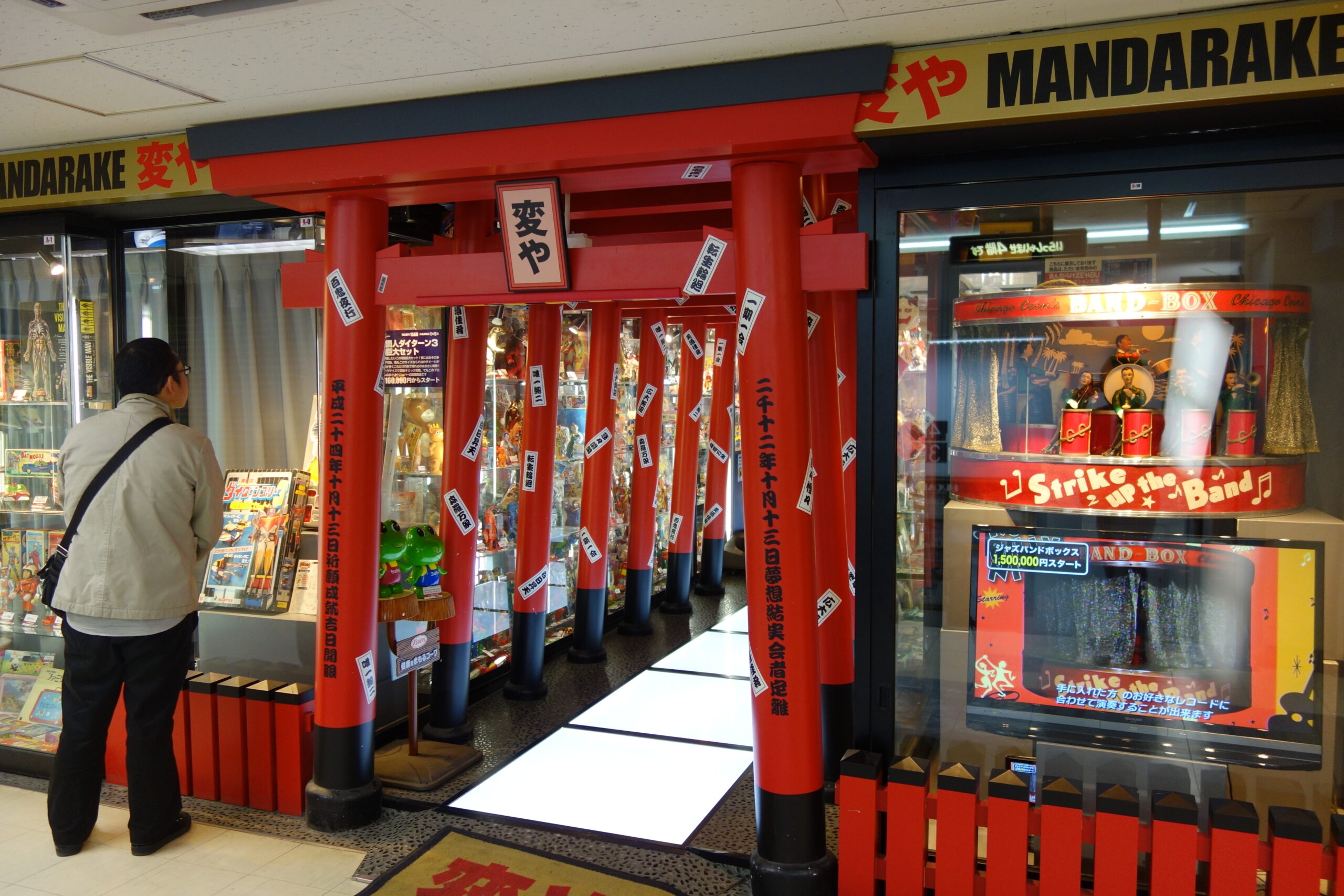
Hen-ya — 4F
Tin toys, chogokin diecast, kaiju sofubi, Henshin Cyborg, and corporate novelty goods stacked until the room reads as a Showa museum. Periodic vintage sofubi clearance sales are worth timing a visit around.
Micro-kan — 2F
The rubber-eraser figure specialist — kinkeshi and gunkeshi — plus 1980s and 90s penny-sweet-shop toys, pro wrestling merchandise and Ghibli goods. A narrow niche nobody else in Tokyo covers at this scale.
Katsudo Shashin-kan — 2F
Japanese cinema posters, original film and television scripts, cinema books. Strongest on the 1950s and 60s golden age and on Toho monster titles.
Kaiba — 4F
Subculture and counterculture books, art photobooks, and a deep spiritual, occult, divination and UFO section. Printed matter, not manga — and the best Japanese fringe-press shelf you will find.
Wink — 3F
Female idol and voice-actress goods: Nogizaka46, Hinatazaka46, Hello!Project, seiyuu trading cards, signed bromides, tour towels. Fitted out like a concert stage, with member-coloured showcases.
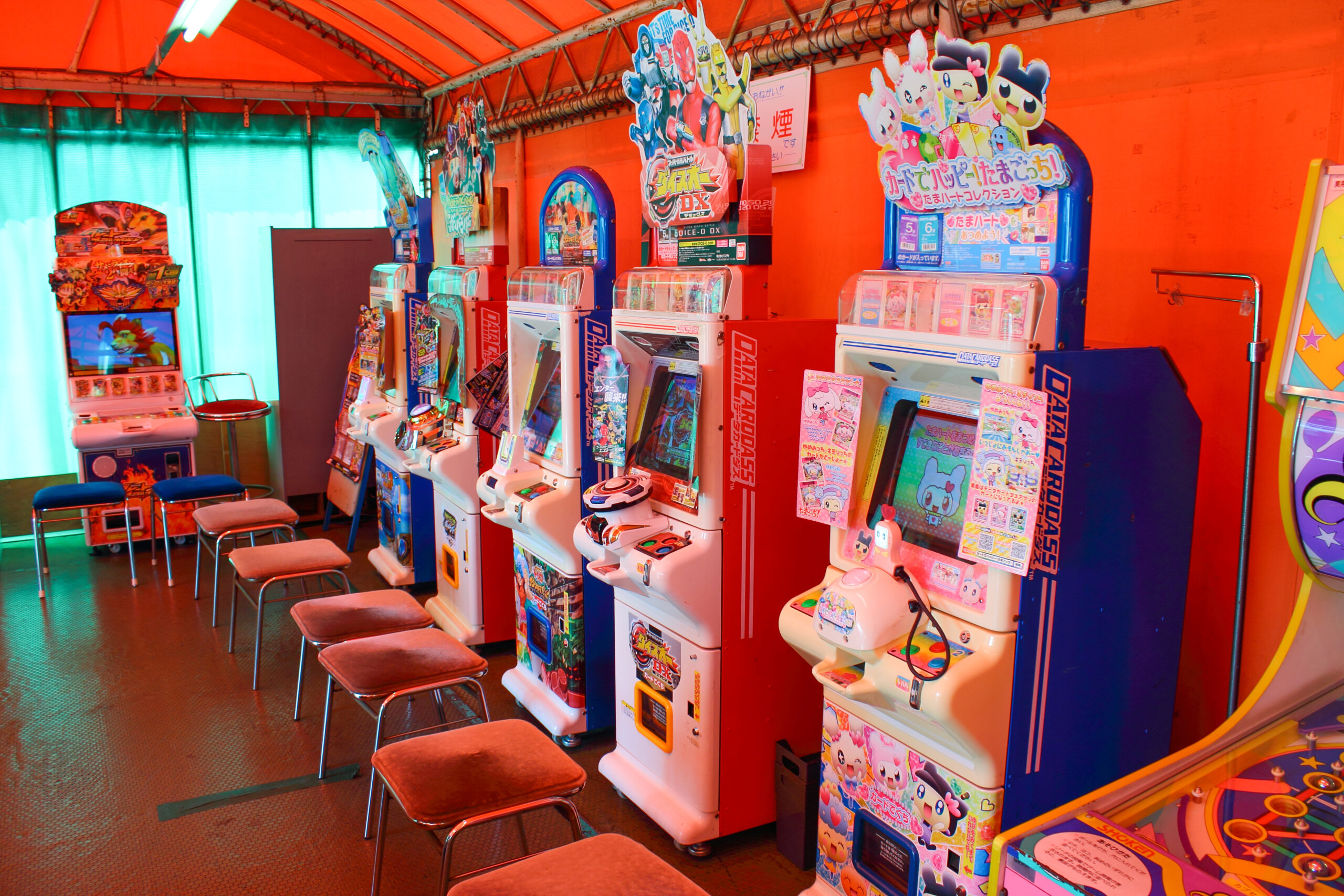
Also worth knowing by name: Konpeito (4F, Showa candy-premium toys), Mania-kan (4F, rental-library manga and Showa children’s magazines), Plastic (4F, model kits plus vintage Barbie, Licca and Blythe), Galaxy (2F, retro console games and hardware), and the Card-kan and Special halls across 2F and 3F for figures and trading cards. Card-kan is on 2F and sells Carddass, old Bikkuriman stickers and phone cards as well as Pokémon and Yu-Gi-Oh singles — our Nakano Broadway card shop guide covers it and the three other card shops in the building.
All Mandarake branches: 12:00–20:00, open daily except the annual February building closure.
The shops that are not Mandarake
TACO ché (3F) is Japan’s best-known independent and zine bookshop: self-published art books, small-press manga, limited editions, indie CDs and tapes, and magazines that never reached normal distribution. Regular in-store exhibitions. 12:00–20:00 · closed Wednesdays
Hakaba no Garou (3F, northeast corner) is a gallery-shop running rotating pop-ups — horror manga, cult film, indie creature sofubi — with shop-exclusive goods produced in-house that exist nowhere else, not even from resellers. Stock turns over completely every few weeks. 11:00–20:00
Jackroad and Betty Road (3F) anchor the floor’s surprising second identity as a watch market: vintage and pre-owned Rolex sports models, Omega, IWC, with Betty Road handling women’s pieces. Trading here since 1987, multilingual, tax-free. It is why a third of 3F is glass cases rather than toys. 11:00–20:30 · open year-round
Fujiya Avic (3F) is Japan’s leading headphone and portable-audio specialist, new and used, with a buyback counter on the same floor. Note it is audio, not cameras — the Fujiya Camera shops are on the streets outside. 10:30–20:00
Euro Surplus (3F) does European military and tactical kit rather than the usual US surplus: German and British packs, plate carriers, chest rigs, some genuine issue items. 12:00–19:00 · closed Mondays and irregular days — check their calendar
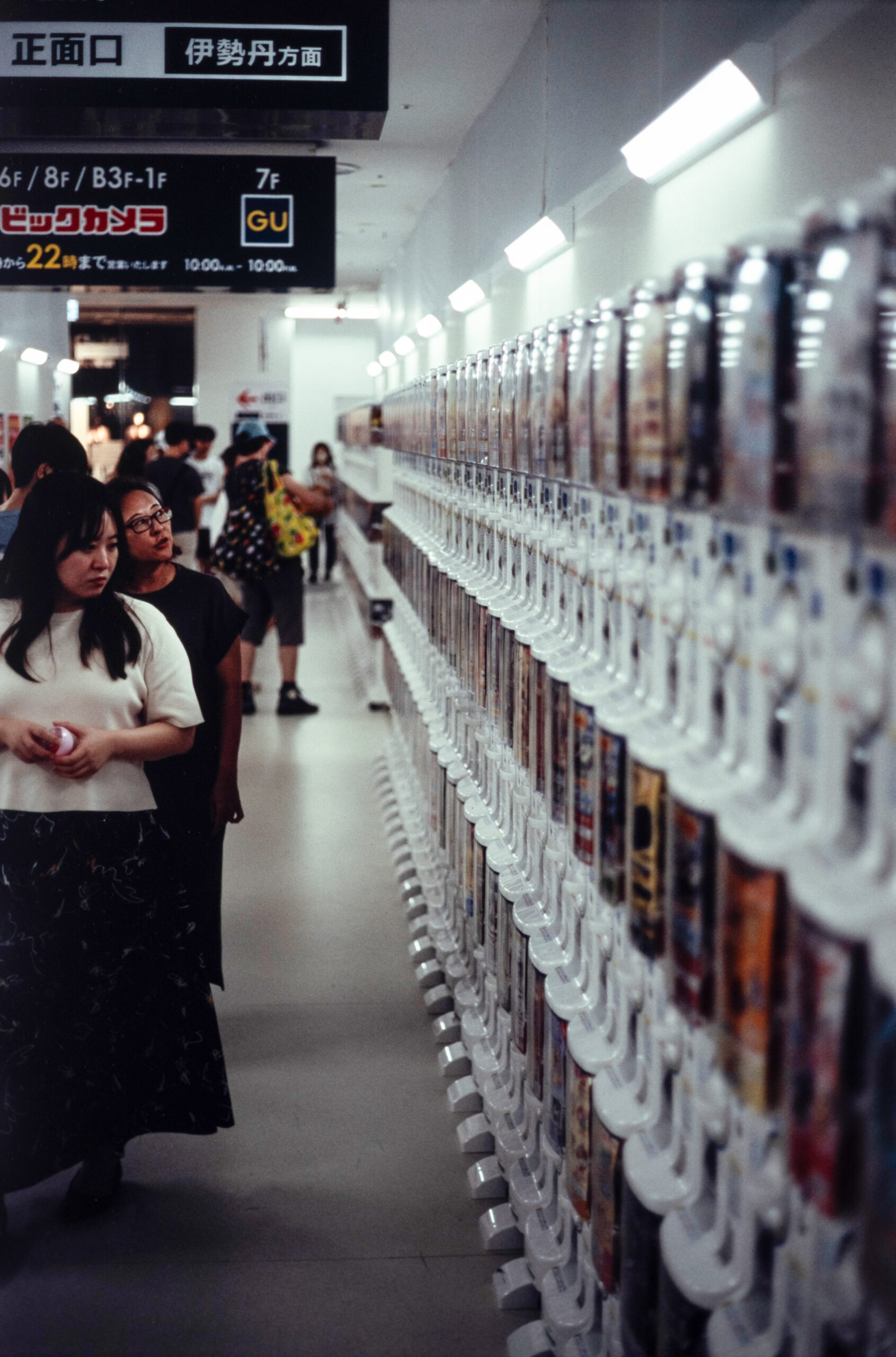
Robot Robot runs three units across 2F and 3F covering figures, sofubi, dolls, American toys and gashapon. Nakano Meikyokudo (2F, since 1968) is an enka and kayokyoku CD specialist that still puts on in-store performances. Nakano TRF (4F) is a fighting-game arcade with a real local scene.
Zingaro is Takashi Murakami’s footprint in the building, spread over three floors: Hidari Zingaro (3F) is the main gallery with rotating shows and free entry, Tonari no Zingaro (4F) is the Kaikai Kiki shop, and Junkissa Zingaro (2F) is a Showa-style coffee house that replaced the former Bar Zingaro in 2023. Junkissa Zingaro: 12:00–19:00 · closed Tuesdays and Wednesdays
And Daily Chico (デイリーチコ, B1) is the eight-tier, eight-flavour soft serve that is the most photographed object in Nakano, run as a side counter by an udon shop that has been here since the building opened. Around ¥1,200 as of mid-2026 — it was ¥550 in 2018, so ignore the price in older guides. Cone only; there is no cup option for the big one, and they will not re-stack it if it goes over. The same counter is a standing soba and udon bar with eleven seats and kake udon under ¥200, and it opens at 10:00, two hours before the Mandarake floors. If you get to Nakano early, this is the thing that is open. 10:00–20:00 · cash
Mandarake’s stock is secondhand by definition — what sits on the shelf today is what somebody sold them last week. If what you actually want is still in print (a current anime CD, an art book, a standard-edition figure), CDJapan lists new domestic releases and ships them overseas directly, which usually beats hunting a used copy at a collector’s markup.
Gone — and still in other guides
- Bar Zingaro — closed. The same 2F space reopened in April 2023 as Junkissa Zingaro, a very different kind of cafe. English guides still list the old name.
- Recomints, the 3F used CD and laser disc shop, closed in 2016 after 25 years. It still appears in older “records in Nakano” lists.
- Mandarake Kaguya and Nanya have both been absorbed into other branches; their stock moved to Plastic on 4F and elsewhere.
- Fujiya Avic once had three units inside Broadway. Two merged into a standalone shop on the street outside; only one remains in the building.
- Nakano Sun Plaza, the landmark used for orientation in almost every English guide, closed in 2023 and is being demolished.
One category gap worth stating plainly: there is no vintage camera specialist inside Nakano Broadway. Camera collectors want the Fujiya Camera shops on the surrounding streets in Nakano 5-chome, not the building itself. Our Nakano used camera shop guide maps Fujiya’s four buildings and the Kitamura counter in Sunmall, with opening hours and tax-free status for each.
Tax-free here, and what changes on 1 November 2026
Used goods qualify for Japan’s tax-free scheme — there is no secondhand exclusion — and Mandarake does operate it in Nakano. What is unusual is the mechanism. At most Mandarake branches the tax comes off at the till; at Nakano you pay the full tax-inclusive price in each shop, keep the receipts, and take them to the Service Counter on 4F for a cash refund. That counter stops handling refunds at 19:30, half an hour before the shops shut. Buy at a quarter to eight on 3F and there is nobody left to refund you.
The usual conditions apply: ¥5,000 before tax in the same store on the same day, your original passport rather than a photocopy, and if you paid by card, the card in your own name.
Mandarake is not the only one. Geo, Junkworld, Sofmap Re Collection and the watch dealer Ginza NJ Time are all registered tax-free shops inside the building. The genuinely small independent units mostly are not, and that still covers a lot of what is interesting here.
From 1 November 2026 the national scheme changes shape. You will pay the tax-inclusive price everywhere and claim the refund at your departure airport instead, once customs has confirmed you are taking the goods out of the country — which means they have to be in your cabin baggage, not shipped ahead and not in the hold. The ¥5,000 minimum survives. Mandarake had not published a revised Nakano procedure when this was written, so treat the 4F counter as correct until you see otherwise.
Where to leave your bags
There are lockers inside Broadway, at the 1F arcade entrance — ¥200 small and ¥300 medium, cash only, open 24 hours and good for up to four days. They are small.
JR Nakano station has the sizes that take a suitcase: ¥400, ¥500 and ¥700, the largest at 35 × 87 × 64 cm. They take ¥100 coins only and they close with the station. The bank outside the north exit is the one to aim for, and it is on your way in.
If those are full, the biggest cheap bank in the area is behind the KFC, two or three minutes from the north exit, at ¥200 and ¥300, cash, 24 hours — but nothing off-station takes a suitcase. All of this is likely to move when the new west gate and Atre open in December 2026.
Practical notes
- Arrive at noon, not in the morning. The Mandarake floors open at 12:00. Come earlier and you are looking at shutters.
- Budget three hours minimum if you are serious, and spend most of it on 3F.
- Bring cash. Cards are widely but not universally accepted in the smaller units.
- Tax-free works here, but not the way it works anywhere else. Mandarake runs it from one counter on 4F rather than at each till, and the national rules change on 1 November 2026. See the section below before you plan around it.
- Photography inside shops is generally not allowed. Ask first, or do not lift the camera.
Buying more than you can carry is the normal outcome here. A proxy and forwarding service like Buyee can consolidate and ship a haul home, and our guide to tax-free shopping and international shipping covers how the rules actually apply to secondhand goods.
Nakano sits on the same line as Tokyo’s other subculture neighbourhoods. Koenji is two stops west for records, vintage and junk; Akihabara is the new-goods counterpart. When you have picked your stops, drop them into the Route & Budget Planner.
Planning the wider day? Our Nakano district guide covers access and fares after the March 2026 revision, the tax-free procedure at the fourth-floor counter, and what has closed since most English guides were written.
Comments