Most English guides to Akihabara’s maid cafes are a list of four names and a sentence each. That is not the information you need. What you need is what an hour actually costs, why people on the street are dressed as maids trying to get you upstairs, and which of the famous names has moved since the guide you are reading was written.
Information in this guide is accurate as of August 2026. Prices are the operators’ own published figures and are dated where they are given — maid cafes revise them more often than most restaurants.
- Cure Maid Café did not close. It moved, six years ago.
- What an hour actually costs
- A maid cafe is not a concept cafe, and the difference is your bill
- The touts, and why nobody has stopped them
- Getting in changed in late 2025
- The rules, which are stricter than visitors expect
- The cafes
- Paying, and the tax-free question
- Closed — and still in other guides
- Nearby
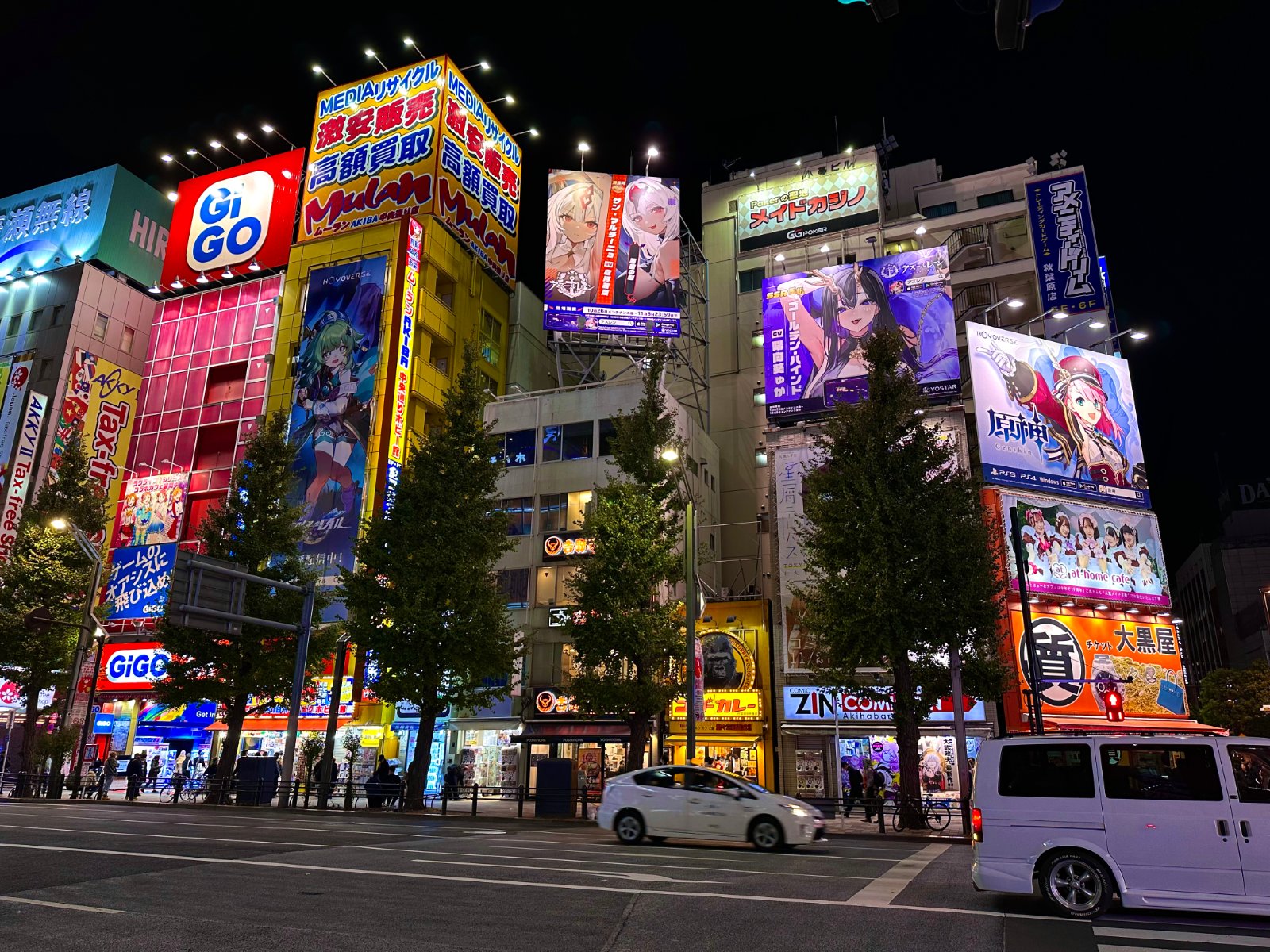
Cure Maid Café did not close. It moved, six years ago.
Cure Maid Café opened in March 2001 and is the first maid cafe in the world. It is still trading — it ran its twenty-fifth anniversary in March 2026 — but it is not where the English guides say it is. The original premises above the Gee!Store / Gachapon Kaikan building closed on 23 November 2020, and the cafe reopened on the fourth floor of the Onoden building on 12 December 2020. That is a different block, about two minutes from the Electric Town exit.
This guide previously listed the old location. So does almost everything else in English. If you have been told Cure Maid closed, that is also wrong — the closure notice that circulated in 2020 was for the old address.
It is also the one cafe on this list with no cover charge: one order per person and that is it, with a ¥300 charge only on the Saturday live-music sessions. Several English guides apply a blanket “cover charge plus food and drinks” line to every maid cafe in Akihabara, which is simply not true of this one.
1-2-7 Sotokanda, Onoden Building 4F · 11:00–20:00, food last orders 19:00, drinks 19:30 · one order per person, 90-minute limit when busy
What an hour actually costs
English guides say “expect ¥1,500 to ¥3,000” and stop. The reason people overspend is that the entry fee is an entry fee — it does not include a drink, and the photos are priced separately again.
Taking @home cafe’s own published figures as of March 2026: entry is ¥850 for an adult, the standard stay is one hour, and one drink per person is compulsory. A drink is around ¥800. So the floor is roughly ¥1,650 before you have done anything memorable. Add two instant photos with a maid at ¥850 each and you are at about ¥3,350 for the hour. There is a cap — two photos per maid, two maids, four total per visit — which is worth knowing before you find it by accident.
Maidreamin, as of its current published table, charges an ¥880 entry per hour plus one order, with extensions at ¥880 again; during its “HYPER” performance slots the model switches to ¥3,800 an hour with unlimited drinks. Photos went to ¥880 in a February 2024 revision. Student and senior rates exist at both chains and are worth asking about.
The trap is the clock. Time-charged cafes generally do not warn you that your hour is nearly up the way a karaoke box does — the extension is billed and you find out at the till. Watch your own time.
A maid cafe is not a concept cafe, and the difference is your bill
English collapses two Japanese categories into one phrase, and this is where visitors get hurt. Meido kissa — maid cafe — is a cafe: you buy a drink, you pay an entry fee, staff stay on the other side of the table. Konkafe, short for concept cafe, is closer to a bar: the cast sits with you, and the revenue comes from cast drinks, the drinks you buy for the staff, which is where a bill stops being predictable. Champagne service in that model runs into the tens of thousands of yen and upwards.
The proportions have inverted over the past decade. Trade reporting in July 2026 put Akihabara’s actual maid cafes at fewer than thirty, down from over a hundred at the peak, while concept cafes were counted at over two hundred as of 2021. Most of the places advertising on the street are not maid cafes. Both get translated as “maid cafe” in English, and that is the gap people fall into.
The rule of thumb: if the price list is published on a website you can read before you go, it is the first kind. If the pricing is explained to you on the pavement, it is the second.
The touts, and why nobody has stopped them
You will be approached on the street by young women in maid costume. This is worth understanding properly, because the usual advice — “just ignore them” — does not explain why they are allowed to be there in the first place.
Chiyoda ward brought in an anti-touting ordinance in April 2014 and designated Akihabara a priority enforcement district on 13 July 2020. But the ordinance carries no fine. A national survey of local touting regulations, updated in December 2025, records that Chiyoda’s ordinance has no penalty provisions at all — only a sequence of guidance, then an order, then publication of the operator’s name. Neighbouring Shinjuku’s equivalent does carry a financial penalty. The ward’s mayor said in December 2021 that fines would be introduced; as of the December 2025 survey they had not been. That is the whole explanation for why the street looks the way it does.
Two things have changed in the operators’ favour, though. Local shops formed the Akihabara Concept Shop Association in January 2022, with self-imposed rules — no more than one person touting per shop, clear and honest price display, no soliciting in a way that alarms passers-by — and it certifies compliant members while working with the ward and Manseibashi police.
And the law changed underneath all of it. The revised Entertainment Business Act took effect on 28 June 2025, and it explicitly prohibits false explanation of prices, exploiting a customer’s romantic feelings to extract orders, and serving items the customer did not order. Coercing payment by intimidation carries penalties. Unlicensed operation went from a maximum of two years to five years, and fines from ¥2 million to ¥10 million, or up to ¥300 million for a company.
So the practical advice has a legal backbone now: do not go anywhere you were invited to from the pavement. Pick a shop whose prices you read online beforehand. And if you are presented with a bill you did not agree to, being charged for items you did not order and being given false price information are both now expressly unlawful — do not pay it under pressure, and call 110.
If you would rather skip the judgement calls entirely, pre-booked experiences with a fixed published price are the other way to do this — Klook’s Akihabara walking tours with an anime-fan guide cover the district with someone who knows which doors are which, and you pay before you arrive rather than at a table.
Getting in changed in late 2025
@home cafe stopped taking EPARK reservations on 4 November 2025. You now register either through the cafe’s own app or at an entry terminal in the building, and you have to register even when there is no queue. When your number is called you have fifteen minutes to check in — you can push it back once — and the seating order follows check-in, not the order you registered. The app wants a date of birth and place of residence, because that is how the age-based discounts are applied.
Cure Maid Café issues numbered tickets when busy, through the LINE mini-app “matoca” from 10:30 if you are near the Onoden building, or on a tablet in the shop from 11:00. You have twenty minutes to appear once called, and seating is capped at ninety minutes. If you do not use LINE, the in-store tablet is your only route, which means going there in person first and coming back.
The rules, which are stricter than visitors expect
These are not folklore; both major chains publish them.
- You may photograph the food and the room. You may not photograph the maids. @home cafe permits stills of dishes and interiors only — no video, no audio recording, and no shots with other customers or staff in frame. Maidreamin’s FAQ allows photos and video provided no maid, kitchen cast or other customer appears.
- Photographs with a maid happen only as paid instant photos. Even then there are limits: no poses that look like contact even when there is none, and nothing that obscures the maid’s face.
- No touching, and no passing over contact details. Maidreamin states plainly that its maids do not sit beside customers or pour drinks — that is the concept-cafe model, not this one.
- No waiting for staff outside and no following them. This is common to the whole industry.
We could not find a published rule from either chain on posting to social media, so treat that as unresolved and ask if it matters to you.
The cafes
Cure Maid Café — the original, and the quiet one
Classical music, Victorian styling, no chanting and no cover charge. If the performance side of maid cafes is precisely what you do not want, this is the one to book. Details in the first section above.
@home cafe — the big one
Five floors of the same building at the Akihabara main branch, plus branches in AKIBA Cultures Zone and inside the Don Quijote. This is the full experience — the chanting, the omurice drawing, the photos. It trialled a real-time AI translation display supporting over a hundred languages at the Cultures Zone branch in early 2025, so it is the chain that has made the most effort for non-Japanese speakers.
Main branch: 1-11-4 Sotokanda, Mitsuwa Building 3F–7F · weekdays 11:00–22:00, weekends and holidays 10:00–22:00, last orders 21:20 · entry ¥850 adult, one drink required, one-hour stay (March 2026 figures)
Maidreamin — seven branches, one of them a live restaurant
The largest footprint in Akihabara with seven shops, including a sixty-seat live restaurant with a stage. Its global site runs in English, Chinese and Korean, and every branch takes the major international cards as well as the Japanese QR wallets. Convenient rather than characterful — but if you turn up without a plan, this is the chain you will find.
Main branch: 3-16-17 Sotokanda, Sumiyoshi Building 6F · weekdays 11:30–23:00, weekends and holidays 10:30–23:00, open year-round · entry ¥880 per hour plus one order
Cafe Mai:lish — the small one that has lasted
Open since 2002 and still independent. No cover charge, one order, ninety minutes. Small enough that the schedule matters: closed Wednesdays, and the weekday hours are short.
3-6-2 Sotokanda, FH Kyowa Square 2F · Mon, Tue, Thu 14:00–20:00, Fri 12:00–20:00, weekends and holidays open, closed Wednesdays
HoneyHoney and Mia Cafe
HoneyHoney runs later than most, to 22:30, and charges for what you order rather than for the door. Mia Cafe, going since 2004, is priced as a bar — around ¥1,100 per thirty minutes with drinks included — which is a reminder that “no cover charge” and “cheap” are not the same claim.
HoneyHoney: 3-7-12 Sotokanda, Isamiya No.8 Building 2F · 12:00–22:30. Mia Cafe: 3-7-9 Sotokanda · weekdays 18:00–22:00, weekends and holidays 10:00–22:00, irregular closing days
Paying, and the tax-free question
Both chains take cash, the major international credit cards and the Japanese QR wallets; Maidreamin lists Visa, Mastercard, JCB, Amex, Diners, Discover and UnionPay alongside PayPay, Rakuten Pay, au PAY, WeChat Pay and Alipay. Small independents may still be cash-only, so carry some.
None of this is tax-free. Japan’s consumption tax exemption applies to goods you carry out of the country, not to services consumed here — food, drink and instant photos in a cafe are outside the scheme entirely, including after the system changes to airport refunds on 1 November 2026. If you want tax-free out of an Akihabara afternoon, it has to come from the shops; see our tax-free guide for how that works.
There is no tipping in Japan and none here. The thing that occupies the same social space is buying an instant photo, which is priced and printed rather than pressed into someone’s hand.
Closed — and still in other guides
- Gundam Café Tokyo Brand Core closed on 30 January 2022 after twelve years, along with the Odaiba and Fukuoka branches; Osaka’s Gundam Square went on 10 January. The Akihabara site is now the Tamashii Nations Store Tokyo, a Bandai figure shop, which opened on 23 June 2022. Turning up expecting the cafe gets you a shop.
- AKB48 Cafe & Shop Akihabara closed on 31 December 2019. A relocation was floated at the time and has not happened.
- Schatzkiste closed on 15 November 2020 after fourteen years — one of the last of the quiet, non-performance maid cafes.
- Little TGV, the railway-themed izakaya, closed on 31 August 2025 after seventeen and a half years. It is still in current English listicles.
- 8bit Cafe is not in Akihabara. It is in Shinjuku Sanchome and it is open. Several guides file it under Akihabara.
- Maidreamin’s “Himitsukichi” branch was renamed “Akihabara AKIBA” on 17 May 2025. Same address, same hours — but ask for Himitsukichi and nobody will know what you mean. Its Idol Street branch shut on 24 February 2025 for a refit and reopened on 25 March; it did not close.
- Individual concept cafes close constantly. Three went in 2026 alone — More Kyun in May, Milk Planet Akihabara on 10 June, Memento Unicorn on 14 June. This is not a district where a two-year-old listicle is safe.
Nearby
Akihabara’s other specialisms have their own guides: anime and manga goods, doujinshi and zines, and retro games. If you are pacing a day across several districts, our route and budget planner will order them and cost them out.

Comments