Akihabara isn’t just about the newest releases — it’s also one of the best places on Earth to hunt for Famicom, Super Famicom, PlayStation, and Neo Geo classics. These four stores cover everything from a legendary multi-floor retro temple to a recently relocated specialist.
Information accurate as of August 2026. Akihabara’s retro shops move and close faster than English-language guides update — two of the four below have relocated since 2024, a long-listed shop has closed for good, and the red arcade tower most guides still use as a landmark now trades under a different name. Confirm before making a special trip.
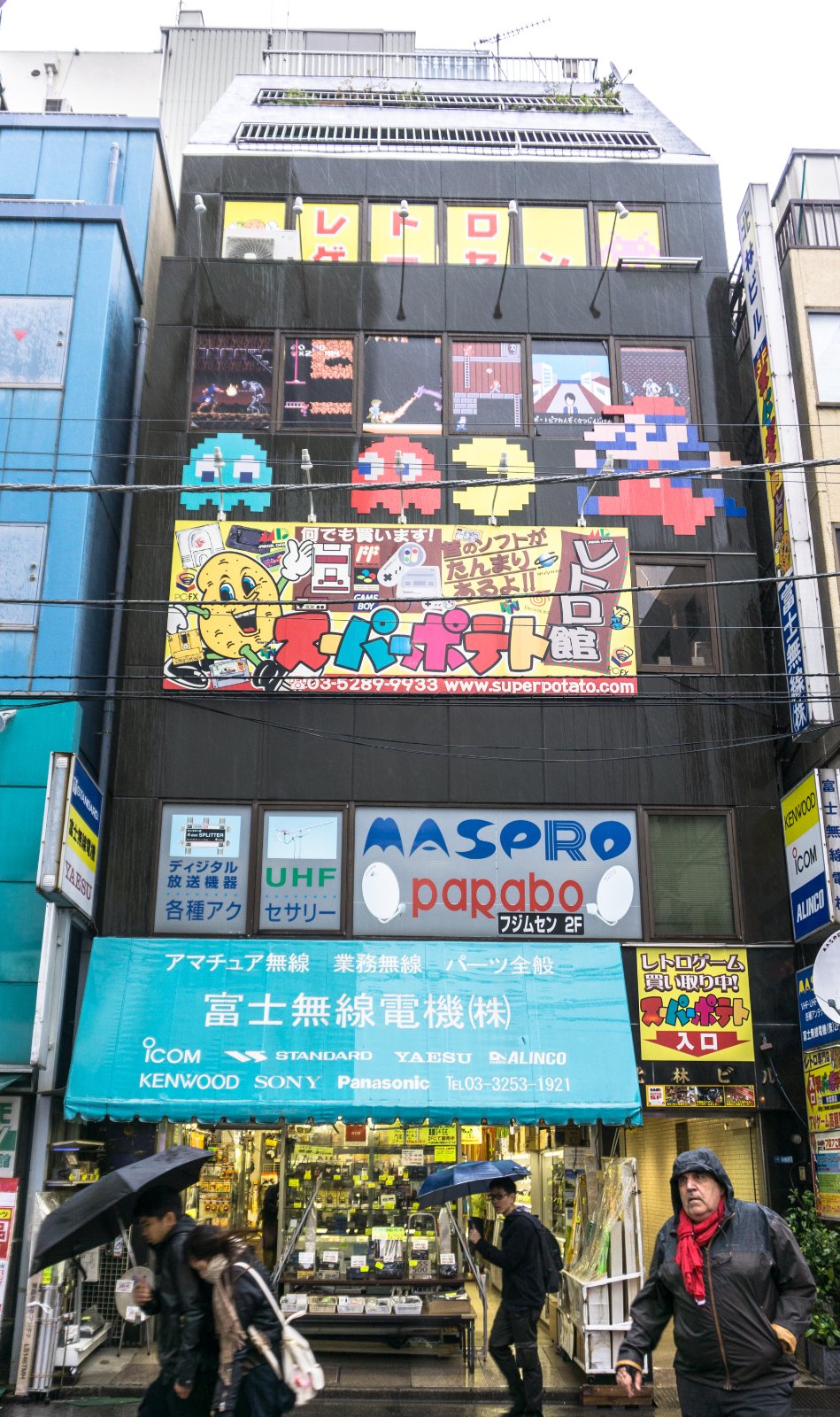
1. Super Potato Akihabara
The best-known retro game shop in Japan, spread across three floors. Hardware and software fill the 3rd and 4th floors, while the 5th floor houses Retro Game Center, a working retro arcade where you can actually play cabinets from the collection. The sheer density of inventory makes it worth the visit even if you don’t buy anything. One thing the English guides still get wrong: the flat-fee, all-you-can-play plan on 5F — written up everywhere as an hour of unlimited play with free snacks — has ended. The cabinets are pay-per-play now.
Kitabayashi Bldg. 3F–5F, 1-11-2 Sotokanda · about 5 minutes from Akihabara Station (Electric Town exit) · 11:00–20:00 on weekdays, with several listings showing a 10:00 opening at weekends and holidays · the retro arcade is on 5F
2. Trader Akihabara (Main Shop)
Trader rebuilt itself in 2024: the old Chuo-dori shop closed on 6 May and the current eight-floor building opened across the street on 23 May. Games occupy the first two floors, with figures, hobby and adult sections stacked above. Be clear about what it is, though — the strength here is recent used software and hardware rather than Famicom-era carts. Come for the volume, and for a price check on anything you saw at Super Potato, not for a curated retro shelf.
Trader Honten Bldg., 4-2-1 Sotokanda · games on 1F–2F of eight · 6–7 minutes from Akihabara Station, up Chuo-dori toward Suehirocho · listed at 11:00–20:00, though other Trader branches vary by day · reopened here on 23 May 2024
3. BEEP Akihabara
A well-regarded specialist, now above ground. Its basement home of ten years was scheduled for demolition, and in June 2026 the shop reopened in the railway arches between Akihabara and Okachimachi. The selection is carefully curated and well preserved rather than vast, and it runs to arcade boards and retro PCs alongside the consoles.
SEEKBASE AKI-OKA MANUFACTURE Building 3, 15-1 Kanda-Neribeicho · 7 minutes from Akihabara Station — the site’s operator signposts it as 3 from the Electric Town gate — or 7 from Okachimachi · weekdays 12:00–20:00, weekends and holidays 11:00–20:00 · closed Wednesdays · moved here on 6 June 2026
4. Retro Game Camp
The collector’s pick, and the antidote to Super Potato’s tourist pricing. Cartridges are tested before they go on the shelf, and anything with a battery-backed save has the battery replaced — the guarantee is a five-year warranty on that battery rather than on the game as a whole, which is still the most useful promise anyone in Akihabara makes about thirty-year-old hardware. A Famicom-era save battery that has never been changed is living on borrowed time, so this matters more than it sounds. Stock is spread over two floors. The shop also lists a second branch, Dungeon, in a basement a minute away, but its status has been reported inconsistently over the years — check the door rather than the website.
New Suehiro Bldg. C, 1F–2F, 3-14-7 Sotokanda · 4–5 minutes from Akihabara Station (Electric Town exit) · 11:00–20:00 · the buy-back counter closes at 18:30 · no closing days are published
How to buy retro games in Akihabara
- Ask whether the save battery has been changed. Famicom, Super Famicom and Game Boy cartridges with battery-backed saves are thirty years old or more. The phrase to look for is 電池交換済み (battery replaced). An untouched original battery will die, and it takes your save file with it.
- Boxed costs far more than loose. 箱説付き means box and manual included and carries a steep premium; a loose cartridge of the same game can be a fraction of the price. Decide which you are buying before you start comparing shops.
- Check the region before you buy hardware. Japanese consoles are NTSC-J. Famicom cartridges do not fit a US NES without an adapter, Super Famicom carts need a converter for a SNES, and PlayStation discs are region-locked. Buying the console alongside the games avoids the whole problem.
- Learn two condition words. 動作確認済み means tested and working. ジャンク means junk — untested or faulty, sold as-is, and no returns. Junk bins are where the bargains and the heartbreak both live.
- Bring cash, and do not haggle. Prices are marked and firm, and smaller shops still prefer cash. Do not count on tax-free either: used goods do qualify under Japanese law, but most small shops are not licensed tax-free stores. Look for the “Japan. Tax-free Shop” sticker.
If a title you want is not on the shelf — and with retro stock that is most titles, most days — Buyee will bid and buy on Yahoo Auctions and Mercari Japan on your behalf and forward the parcel abroad. That is where the deep catalogue actually lives; the Akihabara shops are the curated top layer.
If it is your first time in the district and you would rather not decode it alone, Klook runs a half-day Akihabara walking tour with an anime-fan guide that covers the shop and arcade side as well as Kanda Myojin.
What changed in 2025 and 2026
Two of the buildings English guides use as landmarks are no longer what they say they are, and two additions are worth a detour.
- The red GiGO tower by the Electric Town exit closed on 31 August 2025 after 33 years. Silk Hat Akihabara opened in the same building on 22 November 2025 — nine floors of crane games, cards and rhythm games. It is not a retro shop, but it is the corner you navigate by, and the name on every photo caption is now wrong.
- Mandarake Complex 2 opened on 30 August 2025 near the entrance to Junk Street — a second nine-floor building, separate from the Complex everyone already knows. Games are on the third floor.
- GiGO Building 3 keeps a dedicated retro arcade floor, RETRO:G, on 7F. With Super Potato’s flat-fee plan gone, this is the easiest place to play the machines rather than buy them.
- Suruga-ya’s Akihabara game branch is still trading in Sotokanda 3-chome and is usually the cheapest of the big names for common titles — worth ten minutes before you pay Super Potato’s prices.
Price-checking is the whole game here, and doing it means having data: you will be looking up what a boxed Famicom title actually sells for while standing in front of the shelf. If you have not sorted that yet, a prepaid Japanese eSIM installs before you fly and connects on landing.
Shops that have closed
Akihabara turns over faster than the guides do. Friends Akihabara, which still appears on almost every English list of retro shops, closed on 26 August 2024 after more than twenty years; its building came down by the end of March 2025 and the site is under a redevelopment plan. Getchu-ya, two decades of used PC games a few doors from Retro Game Camp, closed on 31 August 2024. Cross-check any address you are given elsewhere — Trader’s main store moved in May 2024 and BEEP moved in June 2026.
Getting your bearings
Super Potato, Trader and Retro Game Camp sit within a few minutes’ walk of Akihabara Station’s Electric Town exit, so three of the four are a compact loop. BEEP is the one that has moved out of it — follow the railway viaduct north-east toward Okachimachi and it is about seven minutes, and remember it is closed on Wednesdays. Do the Sotokanda three first and finish at BEEP; going the other way means backtracking. If the loop leaves you time, the district’s card shops are the other thing Akihabara has quietly become best in the world at — ten of them are stacked inside Radio Kaikan alone. This pairs naturally with a stop at Akihabara’s doujinshi shops or record stores nearby. If you would rather play the old machines than buy them, the seventh floor of GiGO Akihabara 3 is a dedicated retro arcade floor — see our Akihabara arcade guide, which also covers the nine-floor arcade that replaced the red GiGO building in November 2025. Two older layers of the same district are worth an hour each: the junk and electronic parts buildings, where some shops open for three hours a day, and Ameyoko in Ueno, fifteen minutes north, which is Tokyo’s military surplus street. If you want a second day here without hauling the first day’s haul across town, five hotels sit inside Akihabara and Ueno — where to stay in Tokyo covers them, including one with a noon check-out and a 24-hour laundry.
Planning to combine this with other stops? Our route and budget planner tool can help you work out an order and a rough budget.